What Is an Agritech Lab?
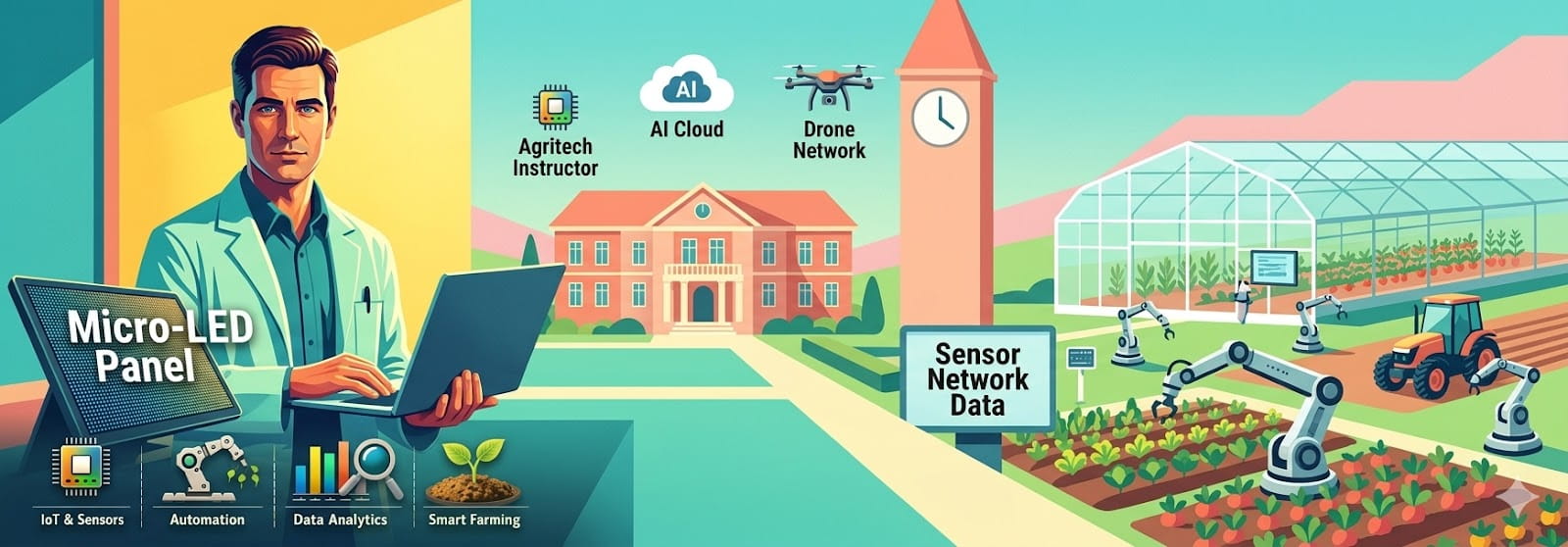
An Agritech Lab – short for Agricultural Technology Laboratory – is a dedicated, hands-on learning environment within a college or university where students bridge the gap between modern technology and real-world farming challenges. It is more than a classroom: it is a simulation of the smart farm of the future, condensed into an accessible, institution-grade workspace.
At its core, an Agritech Lab equips students with the tools to use IoT (Internet of Things) devices, sensor networks, automated irrigation systems, data analytics platforms, and precision farming modules to monitor, model, and optimise agricultural outcomes – all without setting foot on a conventional farm.
Quick Definition
An Agritech Lab is a structured innovation space that combines physical hardware (sensors, IoT kits, drones) with software platforms (data dashboards, AI analytics) to train students in the science and engineering of smart agriculture.
Unlike traditional agriculture labs that focus on seeds, soil tests, or plant biology in isolation, an Agritech Lab is inherently interdisciplinary – drawing from electronics, computer science, environmental science, data engineering, and agronomy simultaneously. This makes it uniquely valuable to B.Tech, B.Sc Agriculture, MBA (Agribusiness), and M.Tech programmes alike.
The HexnBit Agritech Lab Philosophy
HexnBit’s Agritech Lab is designed around the principle that smart farming begins with smarter students. Their lab model helps students explore how sensors, IoT devices, and data analytics can improve irrigation, monitor crop health, and optimise agricultural productivity – directly preparing them for roles in agri-innovation and sustainability.
AgriTech Industry at a Glance
| $22B+ | 4x | 70% | 500K+ |
| Global AgriTech Market by 2027 | Faster Crop Yield Improvement with IoT | Water Savings via Smart Irrigation | Agritech Jobs Projected in India by 2030 |
Why Colleges Need an Agritech Lab Right Now
India feeds 1.4 billion people with a farming workforce that is ageing rapidly and facing intensifying climate stress. The solution isn’t just more land or more labour – it is smarter technology applied at scale. Colleges and universities are uniquely positioned to accelerate this transformation, but only if they equip students with experiential learning infrastructure.
The National Imperative
- India ranks 2nd globally in agricultural output but loses ~40% to inefficiency
- PM-USHA and NEP 2020 both emphasise skill-linked education reform
- AICTE mandates outcome-based education – Agritech Labs deliver measurable outcomes
- Startup India’s Agri vertical funds student innovations from campuses
- National Mission on Sustainable Agriculture (NMSA) needs trained workforce
The Industry Gap
- Only 12% of agriculture graduates are ‘industry-ready’ by employer surveys
- Startups like DeHaat, AgroStar & Ninjacart struggle to hire tech-agri talent
- Precision farming adoption is growing 28% YoY – but skill supply lags
- Drone-based crop monitoring requires certified, trained operators
- Global agri-exports need data-backed quality management professionals
“The farmer of tomorrow will debug sensors before sunrise and read crop analytics at sunset. Colleges that train them today will define India’s food future.”
Core Components of an Agritech Lab
A well-equipped Agritech Lab is built around five hardware-software pillars. Each pillar maps to a distinct skill domain and enables a range of student projects, research activities, and industry collaborations.
1. IoT-Based Smart Farming Kits
The backbone of any Agritech Lab. These kits include microcontrollers (Arduino, Raspberry Pi, ESP32), sensors, relay modules, and connectivity hardware (Wi-Fi, LoRa, Zigbee) that allow students to build end-to-end smart farming prototypes – from field sensors all the way to cloud dashboards. Students learn to program sensors, establish data pipelines, and build alerting systems that mirror what large agri-enterprises deploy in the field.
2. Soil & Water Monitoring Sensor Systems
Includes NPK sensors, pH meters, soil moisture probes, TDS (Total Dissolved Solids) meters, and turbidity sensors. These tools help students understand what the soil ‘says’ and how data-driven decisions can replace intuition-based farming practices.
- Temperature & Humidity Sensors – DHT22 and BME280 modules for microclimate monitoring
- Soil Moisture Probes – Capacitive and resistive probes to trigger automated irrigation
- NPK & pH Analysers – Real-time soil nutrition analysis for precise fertiliser application
- Light Intensity Sensors – PAR sensors to optimise photosynthetically active radiation
- Weather Stations – Mini units tracking wind speed, rainfall, UV index, and pressure
- Pest & Disease Cameras – Computer vision modules for early-stage crop disease detection
3. Automated Irrigation & Control Modules
Drip and sprinkler irrigation systems paired with solenoid valves, flow meters, and relay-controlled pumps. Students build automation scripts that water crops only when soil moisture drops below a threshold – saving water and improving yield simultaneously. Advanced setups incorporate fuzzy logic controllers and ML-based predictive irrigation models trained on historical weather and crop data.
4. Data Analytics & Visualisation Platforms
Tools like Node-RED, Grafana, Tableau, and custom Python dashboards allow students to make sense of the raw sensor streams. They learn to spot anomalies, build predictive models, and present insights to non-technical stakeholders – a skill critical in agri-business roles.
5. Drone Technology Integration
Entry-level agricultural drones (or drone simulation platforms) enable students to learn multispectral imaging, NDVI (Normalised Difference Vegetation Index) analysis, and precision spraying protocols – skills that are in high demand at drone service companies and agri-consulting firms.
Lab Setup Tip
Start with a core IoT + sensor + irrigation module and expand into drones and advanced analytics once the foundational curriculum is running. Trying to build everything at once leads to underutilised hardware.
Step-by-Step Guide to Setting Up an Agritech Lab
Setting up an Agritech Lab is a multi-stage process that involves institutional planning, procurement, integration, and faculty enablement. Here is a practical roadmap institutions can follow:
01 Needs Assessment & Stakeholder Alignment
Identify the departments that will use the lab (Agriculture, CS, Electronics, MBA). Map existing courses to potential Agritech Lab modules. Get buy-in from the Dean, HoDs, and industry advisory board. Define success metrics – student placement rates, research publications, startup spin-offs, or government scheme alignment.
02 Space Planning & Infrastructure
Allocate 400–600 sq. ft. minimum. Ensure stable power supply (UPS-backed), high-speed Wi-Fi, adequate ventilation, water access for soil/irrigation modules, and secure storage for hardware kits. A small greenhouse or grow-room attachment (even 100 sq. ft.) dramatically improves hands-on experience.
03 Equipment Procurement & Vendor Finalisation
Issue a detailed RFQ covering hardware kits, sensor sets, irrigation modules, software licences, and after-sales support SLAs. Evaluate vendors on technical depth, curriculum support, warranty terms, and ability to provide on-site installation and faculty training. HexnBit offers turnkey Agritech Lab solutions with full implementation support.
04 Lab Installation & Commissioning
Install hardware in clearly labelled workstations (ideally 4–6 students per station). Set up the central data server or cloud gateway. Configure sensor networks, run baseline calibration tests, and validate data pipelines end-to-end. Document all installation parameters for reproducibility in student experiments.
05 Faculty Training & Curriculum Mapping
Run a dedicated 3–5 day Faculty Development Programme (FDP) covering hardware operation, data interpretation, and project-based pedagogy. Map Agritech Lab activities to existing syllabus modules. Develop experiment manuals, project guides, and assessment rubrics.
06 Student Induction & Lab Launch
Conduct orientation sessions where students build their first complete IoT-sensor-to-dashboard project as a team. This ‘Day 1 win’ dramatically improves lab engagement. Create a lab usage calendar, assign lab coordinators, and establish a maintenance and troubleshooting protocol.
07 Continuous Improvement & Industry Connect
Review lab utilisation metrics quarterly. Invite industry practitioners for guest lectures and live problem-solving sessions. Encourage students to publish findings, file patents, or enter agri-innovation hackathons. Use industry feedback to iteratively upgrade equipment and curriculum.
Curriculum Integration Strategy
An Agritech Lab delivers maximum value when it is embedded into the academic calendar – not treated as an optional extra. Here is how institutions can systematically integrate lab activities into existing programmes:
| Programme | Relevant Modules | Lab Activities | Integration |
| B.Tech (ECE/CSE) | IoT, Embedded Systems, Data Science | Smart sensor design, automated irrigation controller | Core Course |
| B.Sc Agriculture | Precision Farming, Soil Science | Soil analysis, crop monitoring dashboards | Core Course |
| MBA Agribusiness | Supply Chain, AgriTech Startups | Data-driven business case studies | Elective |
| M.Tech (Agri Engg) | Precision Agriculture, ML in Farming | ML crop prediction, drone NDVI analysis | Core Course |
| Diploma (Agriculture) | Farm Mechanisation, Irrigation | Hands-on drip system automation | Practical |
| All UG/PG (Minor) | Sustainability & Technology | Climate-smart agriculture projects | Minor/Elective |
Project-Based Learning (PBL) Approach
Rather than standalone lab practicals, the most effective Agritech Labs use semester-long, industry-sponsored projects as the primary learning vehicle. Students form cross-disciplinary teams, pick a real agri-problem (e.g., drought stress monitoring for a specific crop in their region), and build an end-to-end technology solution over 12–16 weeks. This approach produces presentation-ready portfolios, teaches team collaboration, and creates IP that institutions can potentially patent or commercialise.
Learning Outcomes for Students
The HexnBit Agritech Lab is built around nine core skill domains, each with clearly measurable outcomes aligned to industry competency frameworks:
- Smart Irrigation – Design and deploy sensor-triggered irrigation systems that reduce water usage by up to 70%
- IoT in Agriculture – Build and programme multi-node IoT sensor networks transmitting real-time field data to cloud dashboards
- Crop Monitoring – Use NDVI analysis, computer vision, and multi-spectral imaging to assess crop health at scale
- Data Analytics – Analyse agricultural datasets using Python, R, or Tableau to generate actionable farming insights
- Automation Systems – Programme relay-controlled systems, actuators, and feedback loops for farm automation workflows
- Precision Farming – Apply variable-rate technology and GPS-guided tools to optimise inputs across heterogeneous field zones
- Sensor Calibration – Perform calibration, validation, and quality assurance on field-deployed sensor systems
- Climate Control – Manage controlled environment agriculture (CEA) systems including greenhouses and vertical farms
- Sustainable Practices – Evaluate the environmental and economic impact of technology interventions on farm sustainability
Funding & Government Scheme Alignment
Setting up an Agritech Lab does not have to be an entirely institution-funded effort. Several central government schemes specifically support technology lab infrastructure in higher education institutions:
| Scheme | Ministry | Applicability | Typical Funding |
| PM-USHA | MoE | State universities and colleges for quality infrastructure | ₹50L – ₹5Cr |
| AICTE IDEA LAB | AICTE | AICTE-approved engineering/tech institutions | ₹30L – ₹1Cr |
| RKVY-RAFTAAR | MoA&FW | Agriculture-focused institutions for innovation labs | ₹25L – ₹2Cr |
| DST-FIST | DST | Universities with active research programmes | ₹30L – ₹80L |
| ICAR Grants | ICAR | Agricultural universities and KVKs | Project-based |
HexnBit’s PM-USHA & AICTE IDEA LAB Support
HexnBit has a dedicated team to help institutions navigate government scheme applications, prepare DPRs (Detailed Project Reports), and align lab specifications to scheme eligibility criteria. Their Agritech Lab is pre-designed to meet PM-USHA and AICTE IDEA Lab standards.
Career Pathways After Agritech Lab Training
Agritech is one of the fastest-growing sectors in the Indian startup ecosystem and globally. Students who graduate with hands-on Agritech Lab experience can pursue a wide range of high-growth careers:
- Precision Agriculture Specialist – Work with agri-firms deploying GPS, drones, and sensor networks to optimise farm operations
- Agricultural IoT Engineer – Design and deploy IoT infrastructure for large-scale farms, agri-logistics, and cold-chain monitoring
- Farm Data Analyst – Translate raw sensor, satellite, and market data into yield forecasts and resource optimisation plans
- Agri-Drone Operator & Analyst – Certified operators for crop spraying, mapping, and multispectral imaging services
- AgriTech Startup Founder – Launch a venture solving last-mile agri challenges with deep technical and market understanding
- Sustainability & ESG Consultant – Advise corporations on sustainable sourcing and regenerative agriculture strategies
Top Recruiters in the Agritech Sector
- DeHaat, AgroStar, Ninjacart, BigHaat, Krishify (Indian AgriTech Startups)
- John Deere, Mahindra Agri, Escorts Kubota (Farm Equipment & Automation)
- Bayer Crop Science, Syngenta, BASF (Crop Protection with digital layers)
- IBM Watson, Microsoft FarmBeats, Google AI for Social Good (Tech firms in Agri)
- NABARD, ICAR, National Institute of Agricultural Extension Management (Public sector)
Frequently Asked Questions
Q: What is an Agritech Lab in a college or university?
A: An Agritech Lab is a dedicated learning space where students use IoT sensors, data analytics tools, automated irrigation systems, and precision farming equipment to explore how technology can make agriculture smarter, more efficient, and sustainable. It bridges classroom theory with real-world agricultural engineering and data science.
Q: What equipment is required to set up an Agritech Lab?
A: Key equipment includes IoT-based smart farming kits (Arduino, Raspberry Pi, ESP32), soil and water monitoring sensors (NPK, pH, moisture, TDS), automated drip/sprinkler irrigation modules with solenoid valves, data analytics platforms (Node-RED, Grafana, Python dashboards), weather monitoring stations, and optionally drone imaging setups.
Q: Is an Agritech Lab eligible for PM-USHA or AICTE IDEA Lab funding?
A: Yes. Agritech Labs align with PM-USHA and AICTE IDEA Lab scheme objectives. Institutions can apply through the respective government portals with a properly prepared Detailed Project Report (DPR). HexnBit offers DPR preparation support as part of their lab setup service.
Q: What career paths open up for students after training in an Agritech Lab?
A: Students can pursue roles such as Precision Agriculture Specialist, Agricultural IoT Engineer, Farm Data Analyst, AgriTech Startup Founder, Agri-Drone Operator, Smart Irrigation Consultant, Sustainability & ESG Analyst, and Controlled Environment Agriculture (CEA) Manager – at startups, MNCs, government organisations, and their own ventures.
Q: How long does it take to set up an Agritech Lab?
A: A standard Agritech Lab setup with HexnBit typically takes 6–12 weeks, covering needs assessment, space planning, procurement, installation, commissioning, and faculty training. Timeline varies based on institution size, infrastructure readiness, and funding source.
Q: What is the minimum space required for an Agritech Lab?
A: A functional Agritech Lab can be set up in 400–600 square feet. For comprehensive labs with a small greenhouse or grow-room module, 800–1,200 sq. ft. is recommended. The lab needs stable power, high-speed internet, water access, and secure ventilated storage for equipment.
Q: Do non-agriculture departments benefit from an Agritech Lab?
A: Absolutely. ECE and CSE students gain hands-on IoT and embedded systems experience. Data science students work on real-world agricultural datasets. MBA students study agritech startup models. Environmental science students explore sustainability applications. It is among the most genuinely interdisciplinary labs a campus can offer.
Ready to Build Your Agritech Lab?
HexnBit provides end-to-end Agritech Lab setup support – from needs assessment and government scheme alignment to installation, faculty training, and curriculum integration.