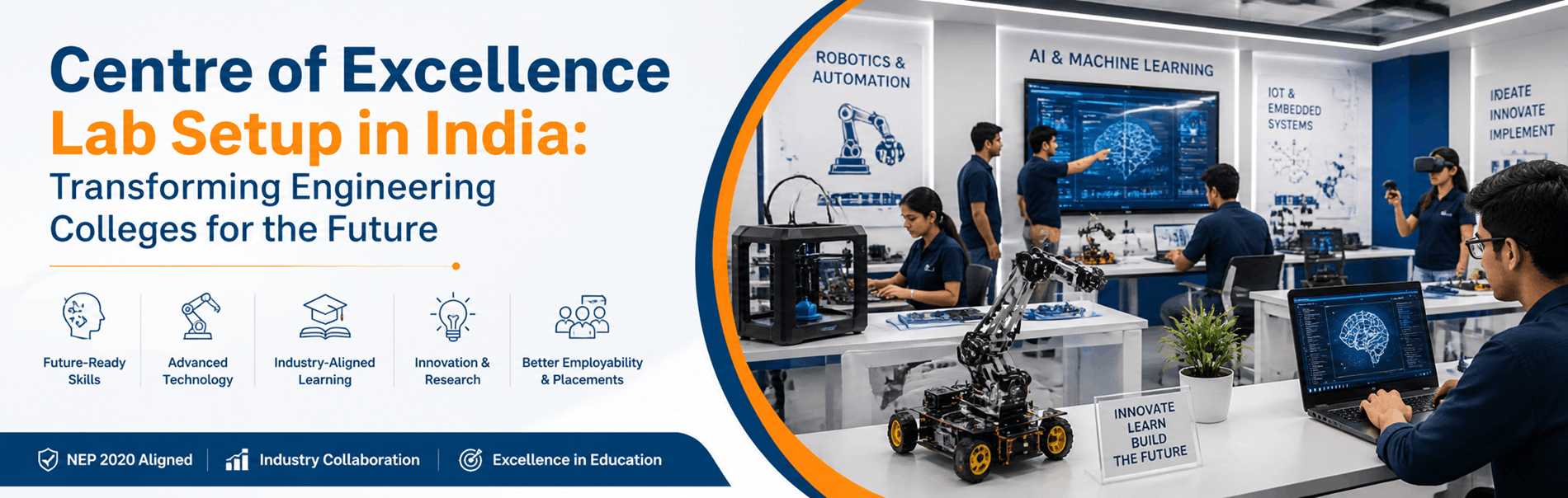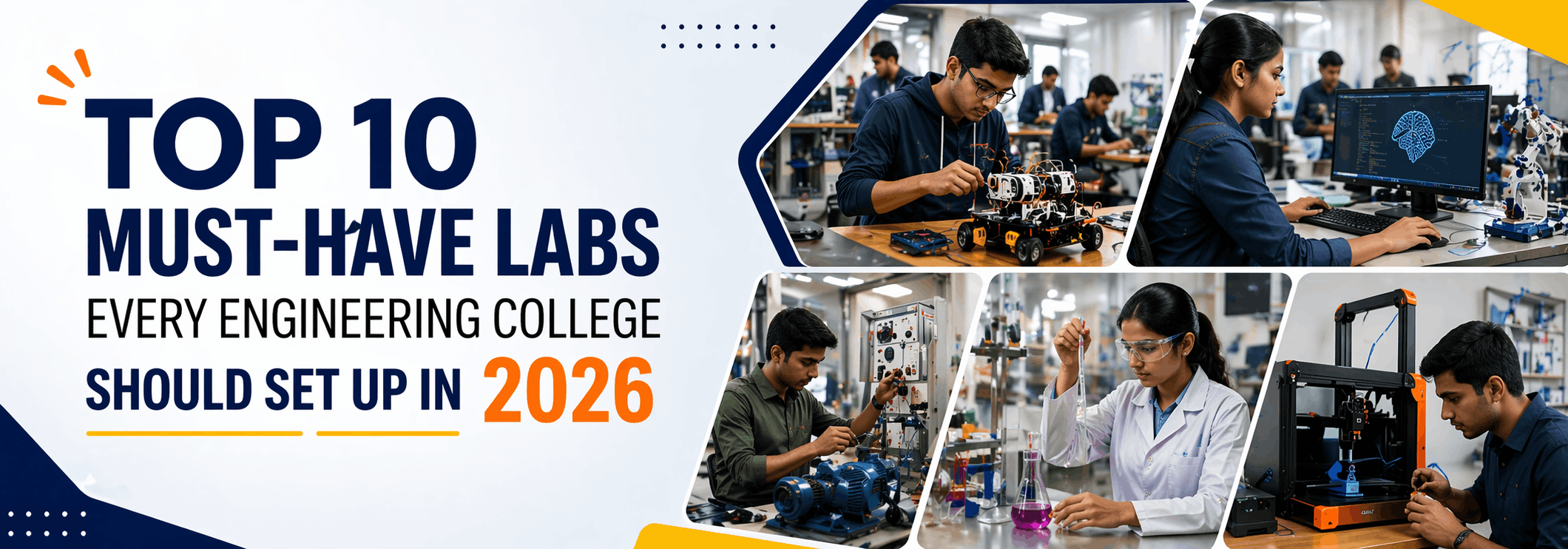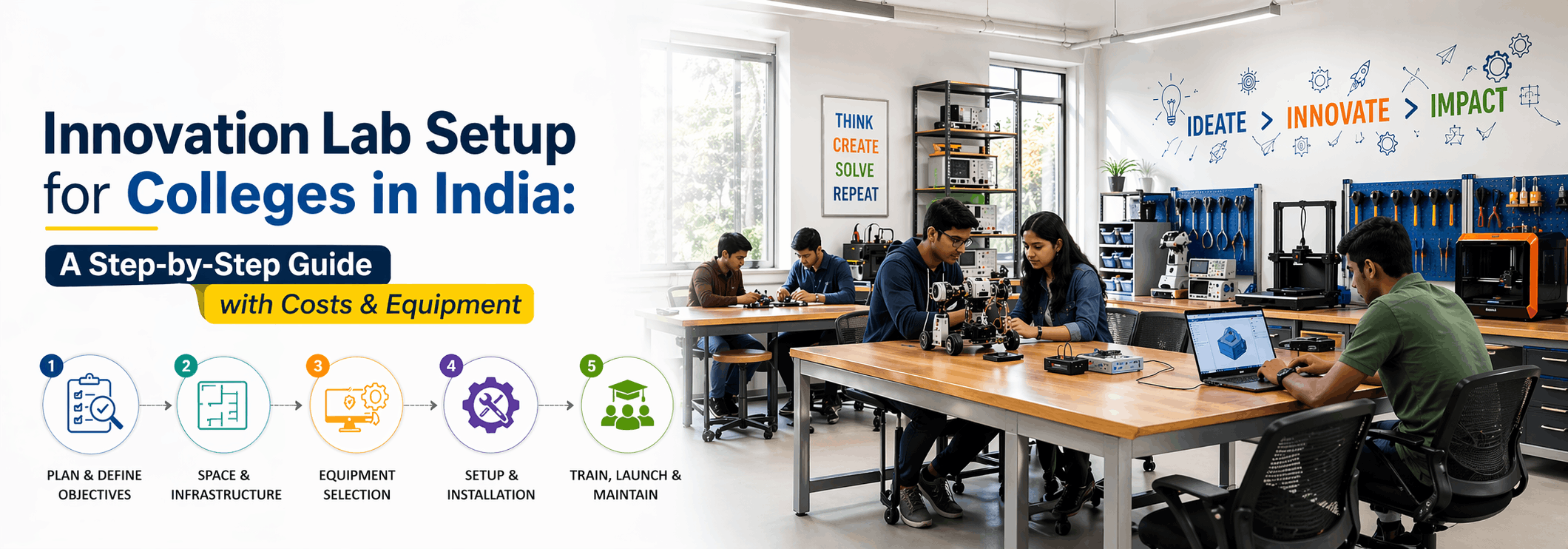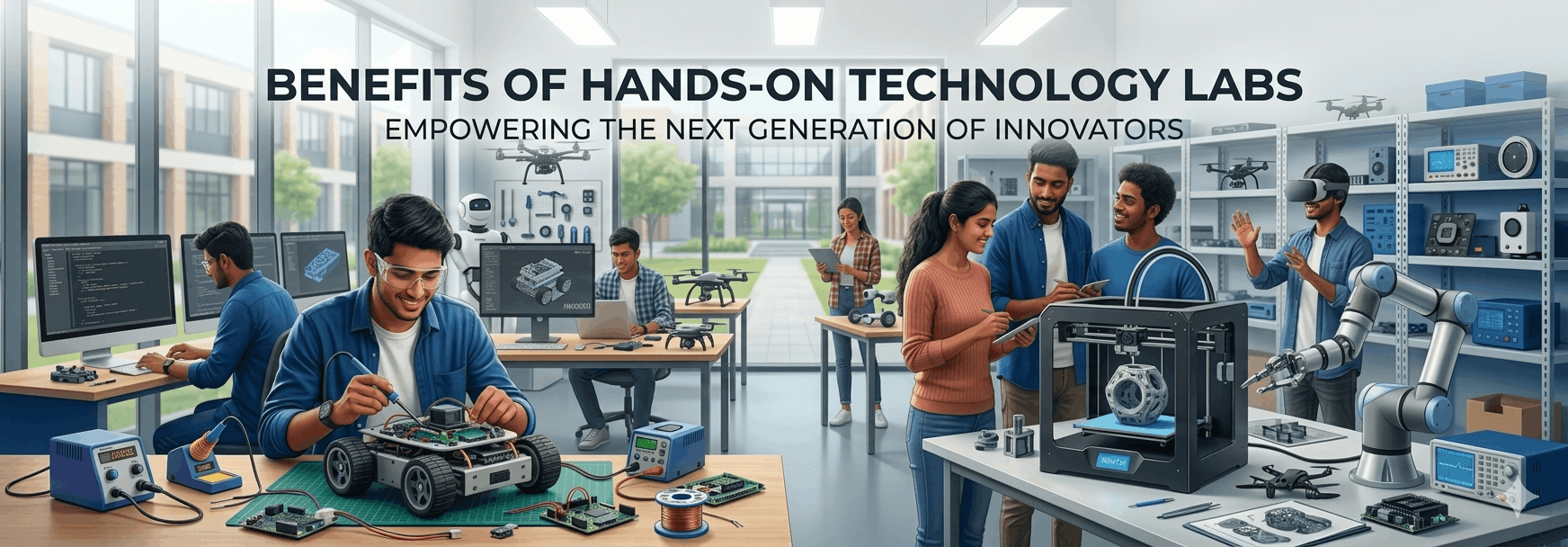
Let’s be honest about something that every placement officer, department head, and concerned parent already knows: a degree alone is no longer enough.
In 2025, companies like Infosys, Tata Consultancy Services, Wipro, and hundreds of high-growth startups are not just asking where a candidate studied – they are asking what that candidate has actually done. Can they train a machine learning model? Have they ever configured a firewall against a real threat? Can they write code that talks to hardware?
These are not trick questions designed to trip students up. They are the baseline expectations of a hiring market that has fundamentally changed. And the colleges and universities that are responding to this shift – by building AI labs, Robotics and IoT labs, and Cybersecurity labs – are seeing the difference where it matters most: on placement day.
This blog explores exactly how these three categories of hands-on technology labs are directly improving student placement outcomes, and why institutions that invest in them are pulling ahead of those that don’t.
The Placement Problem Nobody Wants to Talk About
Every year, India produces millions of engineering and technology graduates. And every year, industry surveys reveal the same uncomfortable truth: a large share of these graduates are not considered job-ready by the companies they are applying to. The gap isn’t about intelligence or potential – Indian students are widely regarded as some of the brightest in the world. The gap is about exposure.
Students who have spent four years studying algorithms from textbooks but have never deployed a model, built an automated system, or run a penetration test are at a genuine disadvantage compared to peers who have done all of those things inside properly equipped labs. Recruiters can sense this difference within the first five minutes of a technical interview.
The good news? This is an entirely solvable problem. And the solution starts with the right lab infrastructure.
How AI and Machine Learning Labs Change the Hiring Conversation
Artificial Intelligence is no longer a specialization – it is a baseline requirement across industries. Banks use it for fraud detection. E-commerce companies use it for recommendation engines. Healthcare providers use it for diagnostic support. Even traditional manufacturing firms are integrating AI into quality control and supply chain management.
When a student walks into a placement interview having trained models, tuned hyperparameters, worked with real datasets, and built end-to-end pipelines in a proper AI and Machine Learning Lab, the conversation changes completely. Instead of explaining what machine learning is, they can talk about what they built – and that shift is transformative.
Inside a well-equipped AI and ML Lab, students gain hands-on experience with:
- Data preprocessing and feature engineering using real-world datasets
- Building and evaluating classification, regression, and clustering models
- Natural language processing projects like sentiment analysis and chatbots
- Computer vision applications including image classification and object detection
- Model deployment on cloud platforms, which is a critical skill that most classroom programs never address
Companies recruiting for data analyst, machine learning engineer, and AI developer roles are actively seeking candidates with this kind of project-backed experience. When a student can point to a portfolio of ML projects built in a structured lab environment, their resume moves to the top of the pile – not by luck, but because they have demonstrated exactly what the employer needs.
At HexNBit, our AI and Machine Learning Labs are designed to replicate real industry workflows. Students don’t just run pre-written code – they build, break, and fix things the way they would on the job. That experience shows during interviews, and recruiters notice.
Robotics and IoT Labs: Creating Engineers That Industries Are Competing to Hire
Here’s something fascinating happening in the Indian manufacturing and automation sector right now: the demand for engineers who understand both software and hardware is far outpacing supply. Companies building automated production lines, smart warehouses, precision agriculture systems, and connected devices are genuinely struggling to find graduates who can bridge that gap.
Robotics and IoT Labs exist precisely to produce those graduates.
When students spend time in a Robotics and IoT Lab, they are not just learning about sensors and microcontrollers in theory – they are wiring them, programming them, debugging them, and integrating them into systems that actually work. They learn to think about problems end-to-end: from the physical hardware layer all the way through to cloud-based data monitoring and analytics.
This cross-domain competency is exceptionally rare and exceptionally valuable. A student who can design a circuit, write the embedded software to run it, connect it to the internet, and build a dashboard to visualize its data is a candidate that automation companies, IoT startups, and manufacturing firms will fight over.
The practical skills built inside these labs – including familiarity with Arduino, Raspberry Pi, industrial PLCs, MQTT protocols, and cloud IoT platforms – are the exact line items that appear on job descriptions across India’s growing manufacturing-tech and startup ecosystems. When a student lists “built an IoT-based water quality monitoring system using sensors, microcontrollers, and cloud integration” on their resume, that is not just impressive. It is a direct answer to what companies are looking for.
Robotics labs also nurture problem-solving under real constraints. The motor doesn’t respond the way the code expected. The sensor gives inconsistent readings. The wireless connection drops intermittently. Students who have navigated these real-world debugging scenarios in lab settings arrive at jobs already knowing how to think clearly when things go wrong – and that is a quality that no written exam can ever test for.
Cybersecurity Labs: Meeting One of the Most Urgent Talent Needs in the Country
India faces a cybersecurity talent crisis. The country is experiencing a rapid expansion of its digital economy – more users, more transactions, more cloud infrastructure, more sensitive data – and the number of qualified cybersecurity professionals is nowhere near enough to protect it.
This shortage means that cybersecurity is one of the fastest-hiring technical fields in the country today. Banks, fintech companies, government agencies, healthcare networks, defense organizations, and technology firms are all actively looking for cybersecurity talent. And the bar for entry, while high in terms of skills, is extremely accessible for students who have had proper lab training.
A Cybersecurity Lab gives students the environment to develop skills that are impossible to build through reading alone. These include:
- Ethical hacking and penetration testing on simulated vulnerable systems
- Network traffic analysis and intrusion detection
- Vulnerability assessment and patching processes
- Cryptography fundamentals applied to real data protection scenarios
- Incident response simulation – understanding how to act when a breach occurs
- Compliance frameworks and security auditing practices
What makes cybersecurity lab training particularly powerful for placements is that certifications like CEH (Certified Ethical Hacker), CompTIA Security+, and EC-Council certifications are highly valued by employers – and students who have practiced these skills in a structured lab environment are far better prepared to earn those certifications alongside their degree.
Recruiters in the cybersecurity field are acutely aware of the difference between a candidate who has studied security concepts and one who has actually run a penetration test, analyzed a packet capture, or configured a firewall policy in a controlled environment. Lab-trained students arrive with confidence, vocabulary, and demonstrated competence. That combination is almost irresistible to a hiring manager who has been struggling to fill a position for months.
The Compounding Effect: Labs Build More Than Technical Skills
One thing that often gets overlooked in the conversation about labs and placements is the range of non-technical skills that hands-on lab environments naturally develop.
Working in a Robotics Lab means collaborating with teammates on a shared project with real deadlines. It means presenting your work, explaining your design choices, defending your approach when a faculty member challenges it. It means learning to communicate technical ideas clearly – which is perhaps the single most underrated skill in any engineer’s toolkit.
Working in a Cybersecurity Lab means developing the patience and methodical discipline to analyze systems carefully before acting, and the judgment to escalate when something is beyond your scope. These are behavioral competencies that HR teams screen for in interviews – and students who have lived them in lab settings demonstrate them naturally.
Working in an AI Lab means learning to sit with ambiguity, iterate on failures, and think statistically about problems. It builds intellectual humility, because anyone who has trained a model that performed terribly knows that confidence must always be backed by evidence.
These soft skills – communication, collaboration, discipline, analytical thinking – are exactly what companies say they want in addition to technical ability. And structured lab environments develop all of them organically, without any special effort. It simply happens when students do real work together.
What Institutions See When Labs Are in Place
For colleges and universities, the placement numbers tell the clearest story. Institutions that have invested in AI, Robotics, and Cybersecurity labs consistently report stronger outcomes across several dimensions: higher offer rates during campus placements, stronger salary packages for graduating students, greater diversity in the companies that recruit on campus, and improved student confidence in technical interviews.
Beyond placements, these labs contribute to institutional reputation in ways that compound over time. Alumni who secure strong positions in high-growth companies come back as guest speakers, mentors, and sometimes as recruiters – creating a self-reinforcing cycle of quality that strengthens the institution year after year.
The investment in a well-equipped, properly supported technology lab is not just an infrastructure decision. It is a strategic commitment to the long-term success of every student who walks through its doors.
HexNBit: Building Labs That Deliver Real Placement Outcomes
At HexNBit, we don’t just supply equipment and walk away. We work with institutions as long-term partners to ensure that every lab we set up actually delivers the outcomes it’s designed for – including measurable improvements in student placement readiness.
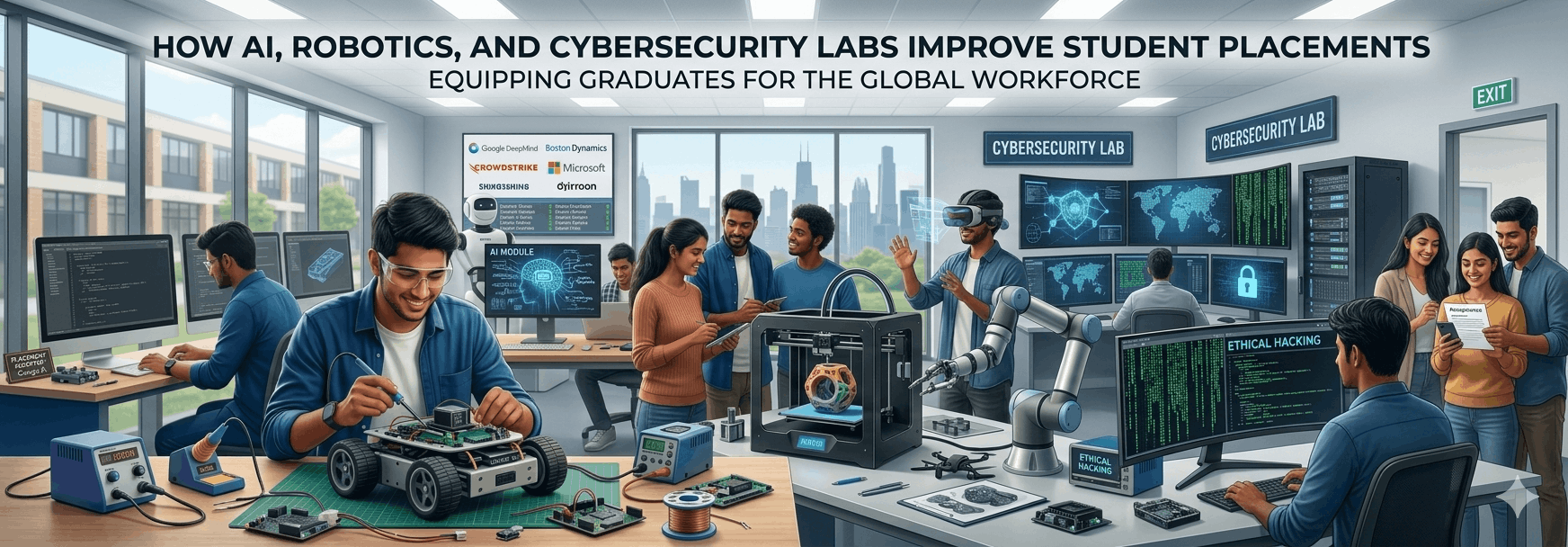
Our AI and Machine Learning Labs, Robotics and IoT Labs, and Cybersecurity Labs are designed around real industry workflows, not textbook exercises. We support institutions through curriculum integration, faculty training, LMS access, and ongoing R&D collaboration – ensuring that students engage with lab facilities deeply and consistently, not just during supervised practicals.
We also help institutions leverage government schemes like AICTE IDEA Labs and PM-USHA to fund state-of-the-art lab infrastructure, making high-quality facilities accessible without placing undue financial strain on college budgets.
If you are a college or university leader thinking about how to improve your placement outcomes, the answer is not a new marketing campaign or a revised syllabus. The answer is giving your students the tools, the environment, and the real-world practice they need to walk into interviews ready to perform.
Conclusion
The job market is not waiting for academia to catch up. Companies are hiring people who can contribute from day one, and they are finding those people at institutions that have taken hands-on learning seriously.
AI labs, Robotics labs, and Cybersecurity labs are not nice-to-haves. They are the infrastructure of a relevant, competitive, placement-driven education. Every student who graduates without access to them is at a disadvantage they should never have had to face.
The institutions that act on this now will be the ones their students thank for the next thirty years of their careers.
Want to see how HexNBit can help transform your institution’s placement outcomes?
Book a Demo Today and speak with our lab setup experts.