There is a moment that every progressive college principal or department head eventually reaches. You are sitting across from a placement officer, or perhaps you are reading another industry report, and the same message lands again -students are not job-ready, the skill gap is real, and the institutions closing that gap are the ones doing something fundamentally different from everyone else.
That “something different” almost always includes an innovation lab.
But then comes the follow-up question that stops most institutions in their tracks: How do we actually set one up?
This guide is the answer to that question -a practical, honest, step-by-step walkthrough of exactly how to plan, fund, design, equip, and run an innovation lab in your college or school. Whether you are a government-aided engineering college exploring AICTE IDEA Lab setup, a private university looking at Robotics, AI, and IoT lab setup, or a school that wants to launch a STEM and AI lab -this guide covers it all.
First, Let’s Clarify What an Innovation Lab Actually Is
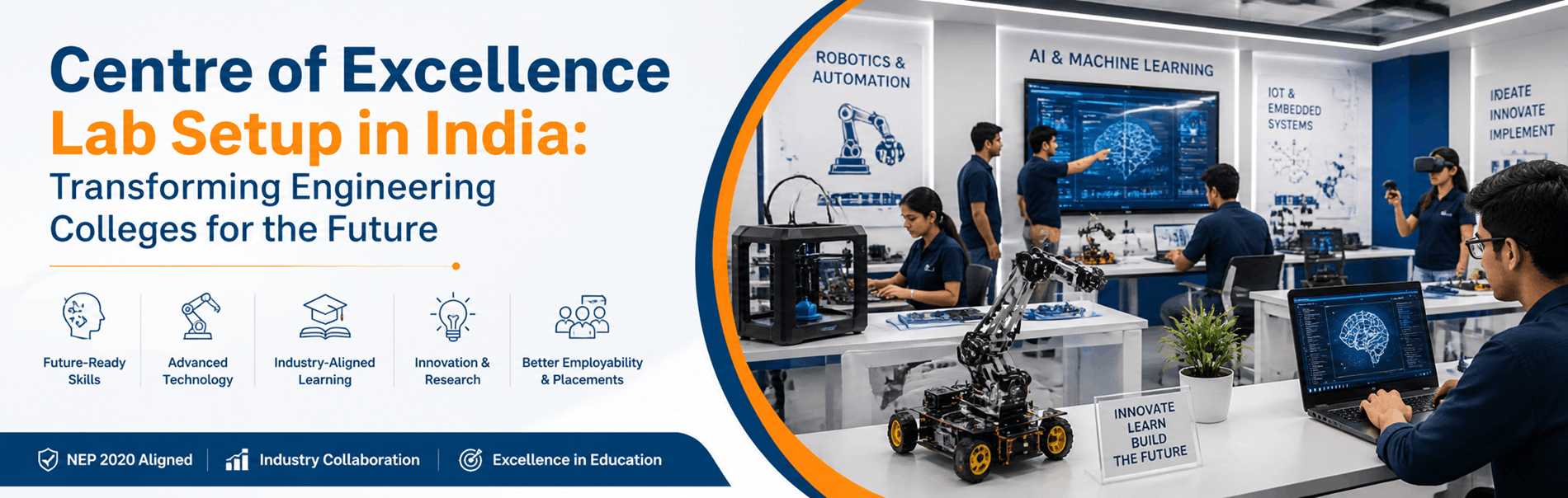
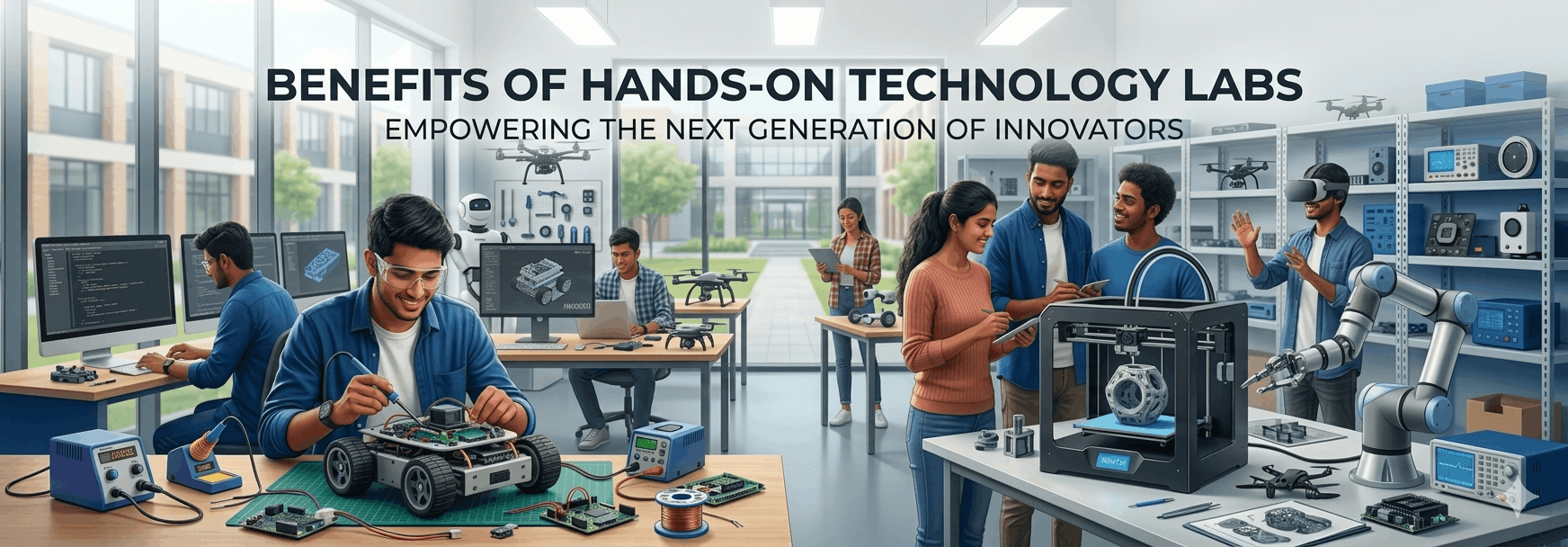
Before diving into the steps, it helps to clear up a common misconception. An innovation lab is not a renamed computer lab. It is not a room with a few 3D printers or a shelf of Arduino kits gathering dust. A true innovation lab -or Centre of Excellence, as it’s also called -is a structured, curriculum-backed, industry-aligned environment where students learn by building real things.
Modern innovation labs integrate technologies like Artificial Intelligence, Machine Learning, Robotics, Internet of Things, Cybersecurity, DevOps and Cloud Computing, Drone Technology, AR/VR, VLSI and Semiconductor Design, and even Agritech. They are multidisciplinary spaces designed for project-based learning, industry collaboration, and student-driven problem solving.
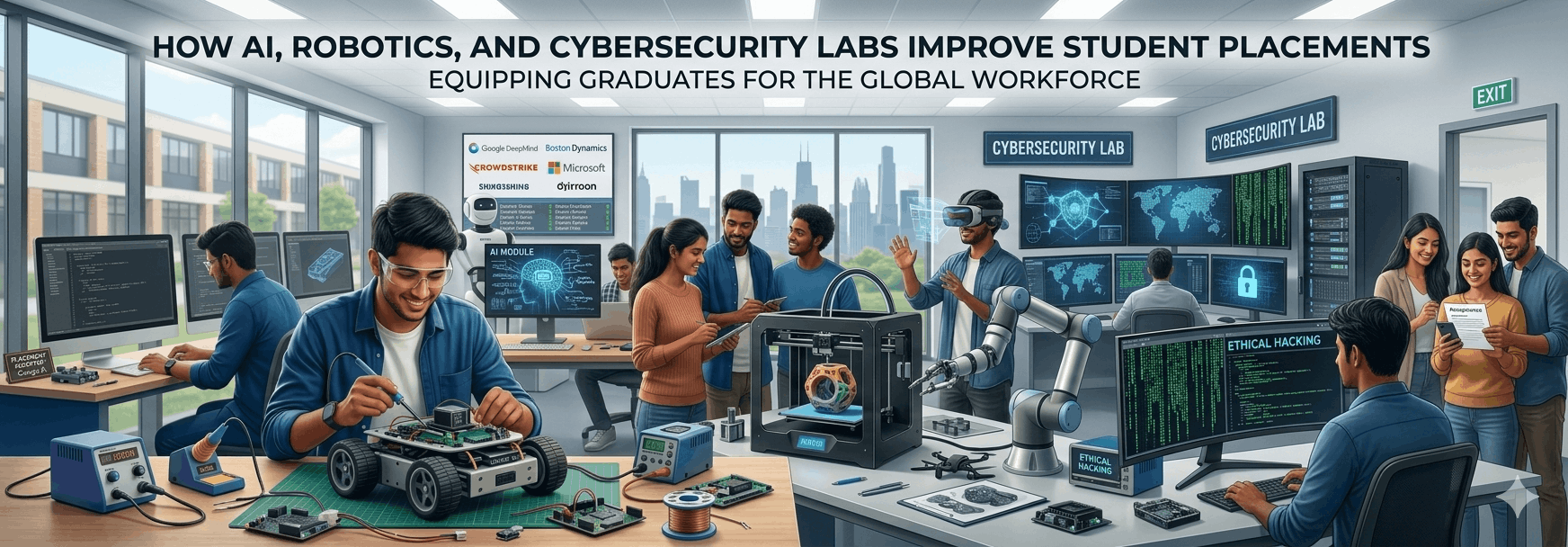
The reason institutions across India are investing in them right now is straightforward: colleges with dedicated innovation and skill labs report significantly higher campus placement rates, stronger research outputs, and better student confidence in technical interviews. An innovation lab is not a luxury expense -it is a competitive investment with measurable returns.
Step 1: Define Your Institution’s Goals Before Anything Else
The single biggest mistake institutions make when setting up an innovation lab is starting with equipment instead of starting with purpose. Buying hardware before defining outcomes is like building a road before deciding where it needs to go.
Start by asking your faculty, placement team, and students a few direct questions. What industries are currently recruiting from your campus? What technical skills are your students consistently weak on during placement drives? What subjects are students most curious about but have no practical exposure to? What does your five-year vision for institutional excellence look like?
The answers to these questions should shape every decision that follows -from the type of lab you build to the budget you seek to the government scheme you apply under. A college with strong placement in IT companies should prioritize an AI and ML Lab alongside a Cybersecurity Lab. An engineering college with an electronics focus should look at VLSI and Robotics. A school in a semi-urban or rural area might find a STEM and AI Lab setup the most impactful starting point.
Getting this foundation right means everything else -funding, design, curriculum, faculty training -can align toward a single, clear purpose.
Step 2: Explore Government Funding -This Step Changes Everything
Here is information that many institutions in India are simply not aware of: you may not have to fund your innovation lab entirely from your own budget. The Government of India offers several schemes specifically designed to help colleges and schools build exactly this kind of infrastructure.
AICTE IDEA Lab is one of the most significant. The AICTE Innovation, Design and Entrepreneurship Academy (IDEA) Lab program provides funding support and institutional recognition for engineering colleges that set up multidisciplinary innovation spaces promoting the “learn by doing” model. AICTE IDEA Lab setup for engineering colleges is one of the most impactful infrastructure investments an institution can make -and with proper proposal support, the funding process is far more accessible than most administrators assume.
PM-USHA (Pradhan Mantri Uchchatar Shiksha Abhiyan) is another powerful avenue. This Government of India scheme focuses on enhancing higher education quality through infrastructure development, Centres of Excellence, and skill-based learning. Institutions can apply for PM-USHA grants specifically to fund innovation lab infrastructure -covering equipment, design, and implementation costs.
Navigating these schemes, however, requires detailed proposal preparation, proper documentation, and alignment with prescribed guidelines. This is where working with an experienced end-to-end innovation lab solution provider in India -like HexNBit -makes a decisive difference. Our team has guided multiple institutions through the AICTE and PM-USHA application processes, significantly improving their approval outcomes and ensuring the lab that gets built actually meets the scheme’s requirements.
Do not skip this step. The right funding pathway can make a lab that seemed financially out of reach entirely viable.
Step 3: Choose the Right Type of Lab for Your Institution
Once your goals are clear and your funding options are mapped, the next step is choosing which type -or combination -of innovation labs best serves your students and institution.
Here is a practical breakdown of the most impactful options for schools and colleges in India today:
AI and Machine Learning Lab equips students with skills in data science, neural networks, natural language processing, and computer vision. This is one of the highest-demand lab types for engineering and IT colleges, given that AI skills are now a baseline requirement across every major sector.
Robotics, AI, and IoT Lab is ideal for engineering colleges wanting to bridge hardware and software competencies. Students work with microcontrollers, sensors, automation systems, and cloud IoT platforms -building the cross-domain skills that manufacturing and tech companies are actively hiring for.
Cybersecurity Lab addresses one of the most urgent talent shortages in the country. Students practice ethical hacking, penetration testing, network defense, and incident response in a safe, simulated environment.
DevOps and Cloud Lab prepares students for modern software development workflows -CI/CD pipelines, containerization, and multi-cloud deployment strategies.
STEM and AI Lab for schools is the entry point for younger students. These labs introduce foundational concepts in coding, robotics, basic electronics, and AI through age-appropriate, project-based activities that build curiosity and confidence early.
Drone Technology, AR/VR, Agritech, VLSI, and Chip Design Labs serve more specialized student populations, particularly in aerospace engineering, design, agriculture, and advanced electronics programs.
HexNBit offers innovation lab setup services across all of these categories, with fully customized solutions based on your institution’s profile, student demographics, and budget parameters.
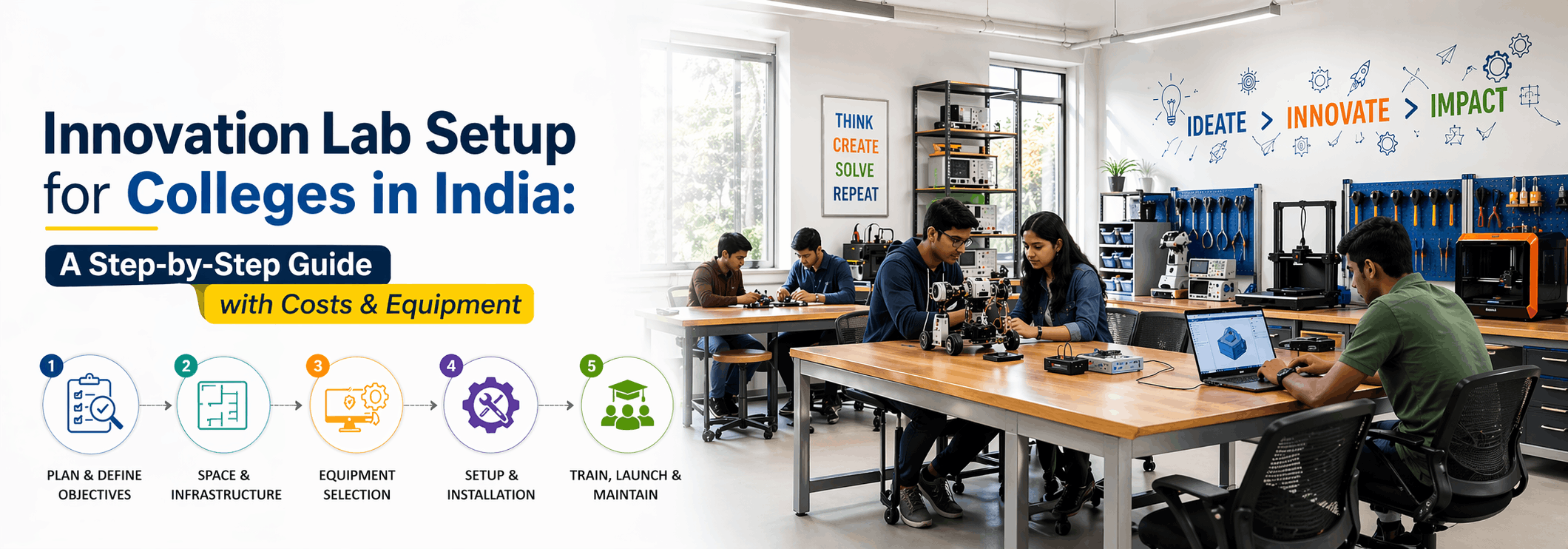
Step 4: Plan the Physical Space and Infrastructure
An innovation lab’s physical environment matters more than most people initially realize. The space you design shapes how students interact with equipment, collaborate on projects, and develop creative confidence.
When planning the physical layout, think in zones. An open collaborative zone in the center for group projects and presentations. Individual workstations around the perimeter for focused, independent work. A dedicated hardware section for robotics, electronics assembly, and drone components. A display wall for project documentation and student achievements. Adequate storage for kits, components, and tools.
Beyond the layout, attend carefully to the supporting infrastructure. Innovation labs need reliable, high-speed internet connectivity -many experiments and cloud-based activities simply cannot function without it. Power outlets must be sufficient in number and placement for the hardware you will deploy. Proper ventilation is essential for labs with soldering equipment or drone components. Network infrastructure for IoT labs requires specific planning around local server connectivity and wireless protocols.
On the topic of innovation lab costs and requirements for schools and colleges in India: the investment varies considerably depending on the type of lab, the scale of equipment, and the level of curriculum support included. A basic STEM and AI lab for a school can be set up at a fraction of the cost of a full-scale Robotics, AI, and IoT lab for a university. A credible end-to-end innovation lab solution provider will give you transparent, itemized cost breakdowns -not vague package quotes -so you can plan accurately and apply for the right level of funding.
Step 5: Procure Industry-Aligned Equipment and Software
Equipment selection is where many self-managed lab setup projects go wrong. Institutions purchase generic hardware that looks impressive on paper but doesn’t align with actual industry tools. Students graduate having used equipment they will never encounter on the job -which defeats the entire purpose.
The right approach is to work backward from industry requirements. What tools are AI engineers actually using? What platforms do cloud architects deploy on? What embedded systems do IoT hardware engineers work with? The answers to these questions define the equipment your lab should contain.
For a Robotics, AI, and IoT lab setup for colleges, this means Arduino and Raspberry Pi boards for embedded programming, industrial-grade sensors and actuators for automation projects, GPU-enabled workstations for machine learning, and cloud IoT platforms for real-time data monitoring. For a Cybersecurity Lab, it means dedicated virtual machines with pre-configured vulnerable systems for penetration testing, network analyzers, and SIEM tools.
HexNBit’s equipment packages are built specifically around this industry-first logic -ensuring every tool in your lab reflects current workplace requirements, not outdated academic standards.
Step 6: Integrate Curriculum and LMS from Day One
An equipped lab without a curriculum is just an expensive storage room. The learning outcomes of your innovation lab depend entirely on how deliberately and consistently students engage with it. That requires structured, progressive, project-based academic programming.
Every HexNBit lab setup includes integrated LMS (Learning Management System) access, providing students with self-paced learning modules, industry-relevant projects, assessments, and certification pathways. This ensures that lab time is purposeful, trackable, and aligned with what employers are looking for -not just free experimentation with no learning arc.
Curriculum should progress from foundational skills to complex, multidisciplinary projects. A student in an AI lab should move from understanding data structures, to training simple models, to deploying a full production-ready application -with every step documented and assessed.
Step 7: Train Your Faculty Before You Open the Lab
This step is consistently underestimated, and consistently the reason labs underperform. Even the best-equipped, best-designed innovation lab fails to deliver outcomes if the faculty guiding students are not confident with the tools and the pedagogy.
Faculty development must happen before the lab opens -not as an afterthought. Initial orientation should cover technical competency with the lab’s equipment and software, project-based teaching methodologies, assessment approaches for hands-on work, and lab governance procedures.
HexNBit builds comprehensive faculty training into every lab setup engagement, including initial workshops, ongoing technical support, refresher programs, and coordination with industry experts for guest sessions and mentorship. This ensures the lab has institutional champions who drive student engagement from the inside.
Step 8: Launch, Measure, and Keep Improving
Once your lab is live, the work is not over -it is just beginning. Institutions that get the most out of their innovation labs are those that track outcomes consistently and use that data to continuously improve.
Key metrics to monitor include student participation rates, project completion numbers, placement results for lab-trained students versus non-lab-trained students, research papers and publications, and startup activity emerging from the lab. These numbers tell you what is working, what needs strengthening, and how to make the case for future investment or expansion.
Why Partner with HexNBit for Your Innovation Lab Setup
HexNBit is one of India’s most trusted end-to-end innovation lab solution providers. We have set up innovation labs across engineering colleges, polytechnics, universities, and schools -covering AI and Machine Learning, Robotics and IoT, Cybersecurity, DevOps and Cloud, VLSI and Semiconductor, Drone Technology, AR/VR, Agritech, and STEM labs.
What separates us from generic equipment vendors is that we treat every engagement as a long-term partnership, not a one-time transaction. We support institutions through goal definition, government scheme applications (AICTE IDEA Lab and PM-USHA), lab design and infrastructure planning, equipment sourcing and installation, curriculum and LMS integration, faculty training, and ongoing R&D collaboration.
If your institution is ready to take the first step toward building an innovation lab that genuinely changes student outcomes, we are ready to help you do it right.
Conclusion
Setting up an innovation lab in your college or school is one of the highest-impact investments your institution can make for its students, its faculty, and its long-term reputation. The process has clear steps -from defining goals and exploring funding, to designing space, procuring equipment, building curriculum, training faculty, and measuring outcomes.
The institutions that act on this thoughtfully and with the right partner will be the ones students choose, parents trust, and employers return to year after year.
Ready to build your innovation lab? Book a free consultation with HexNBit today and let’s design the right lab for your institution.