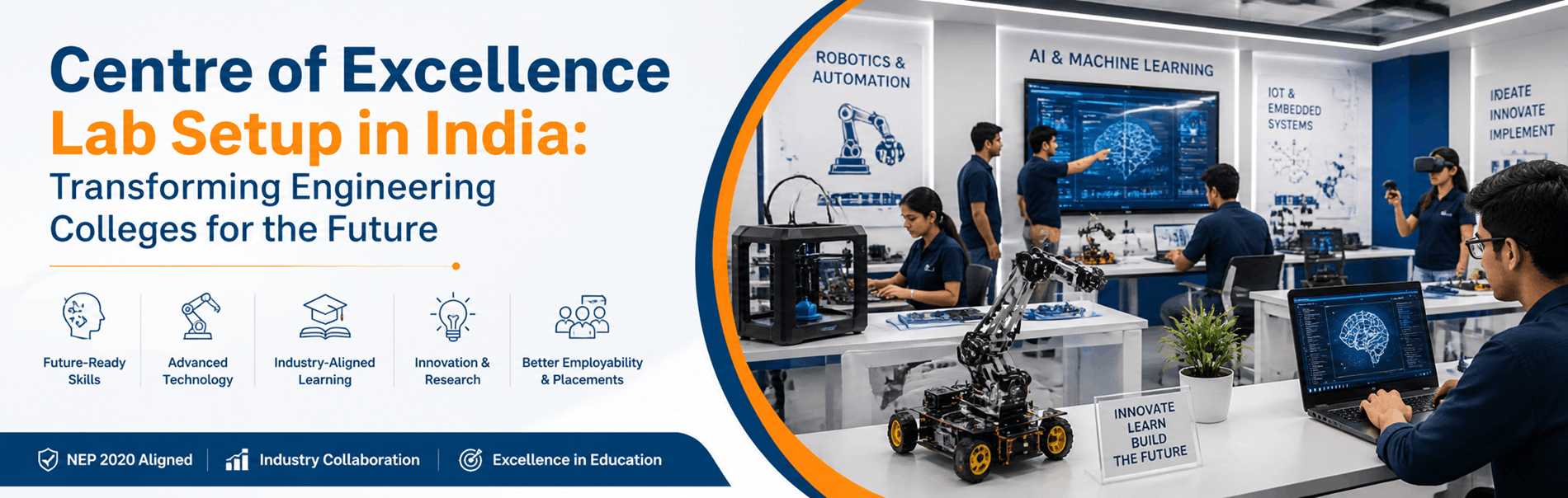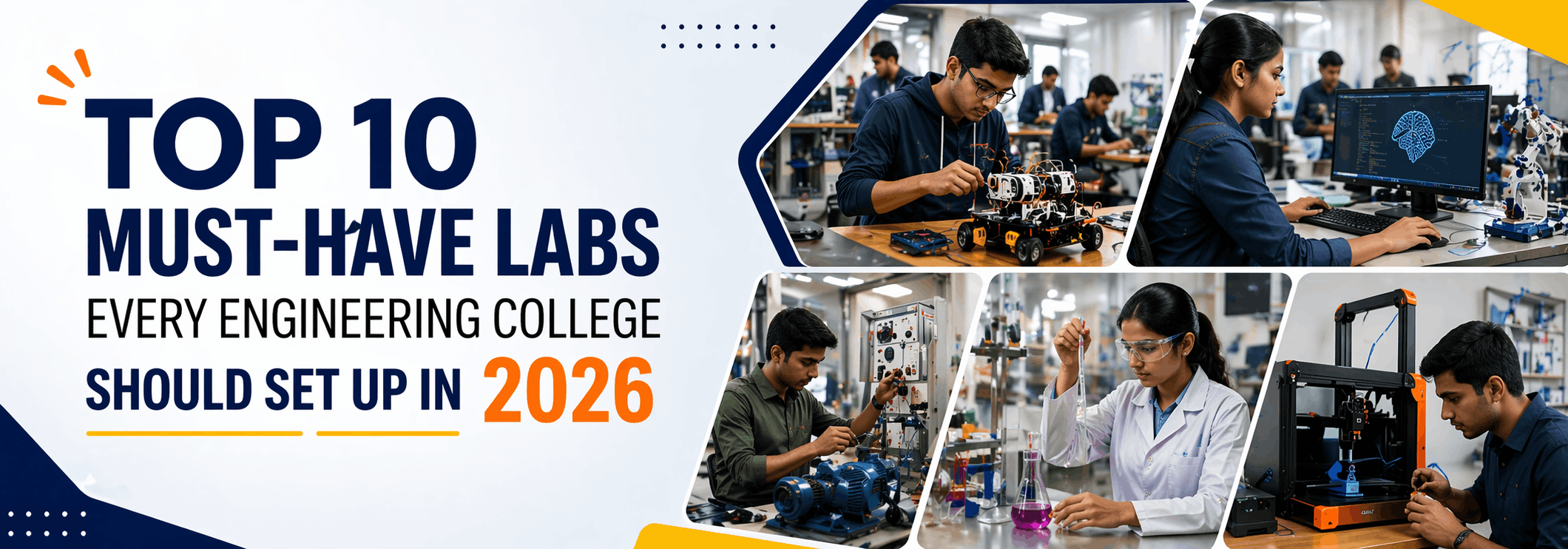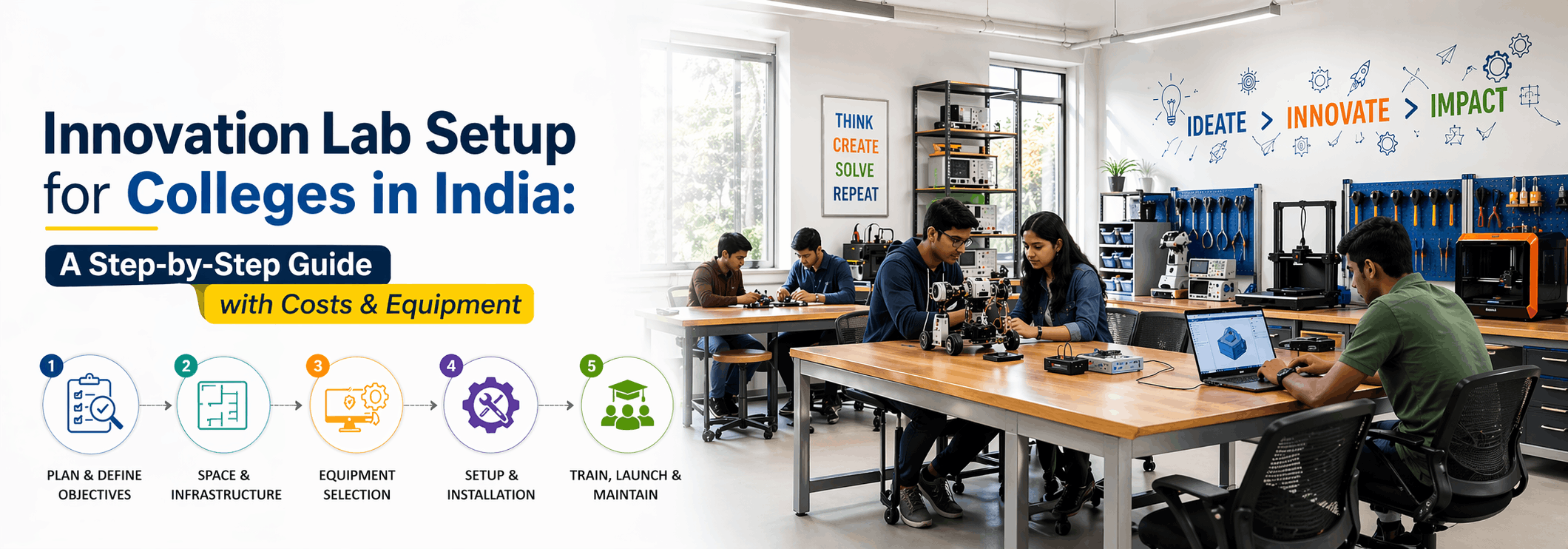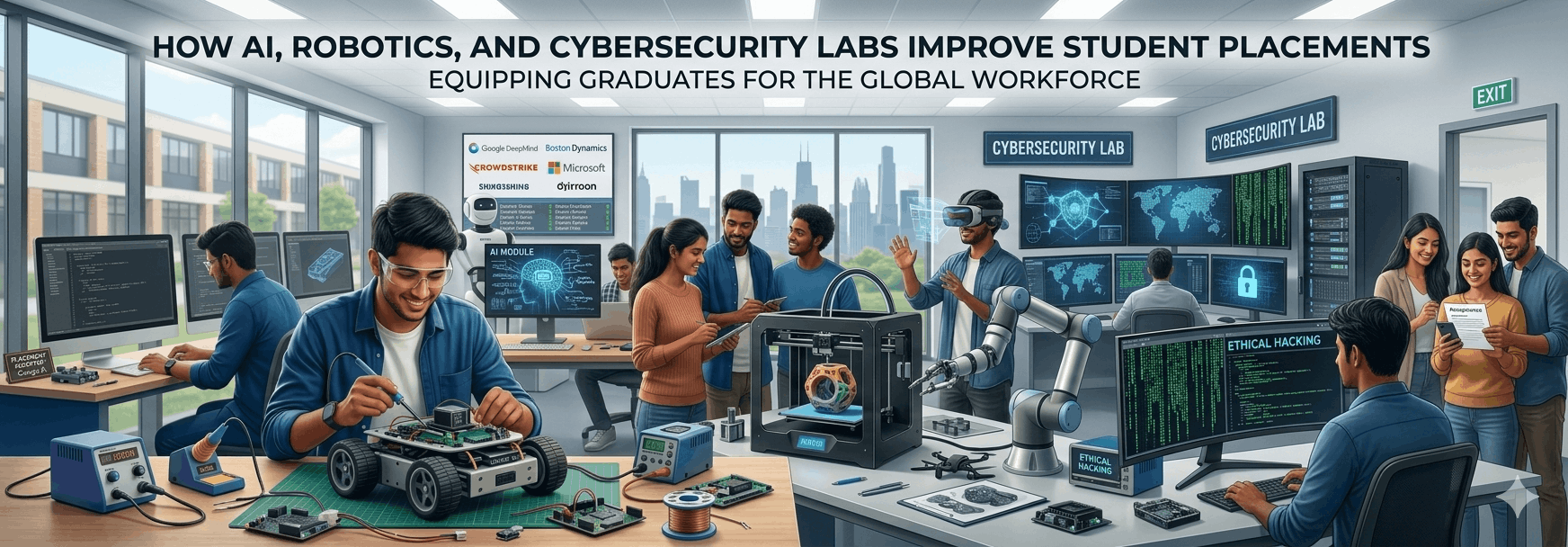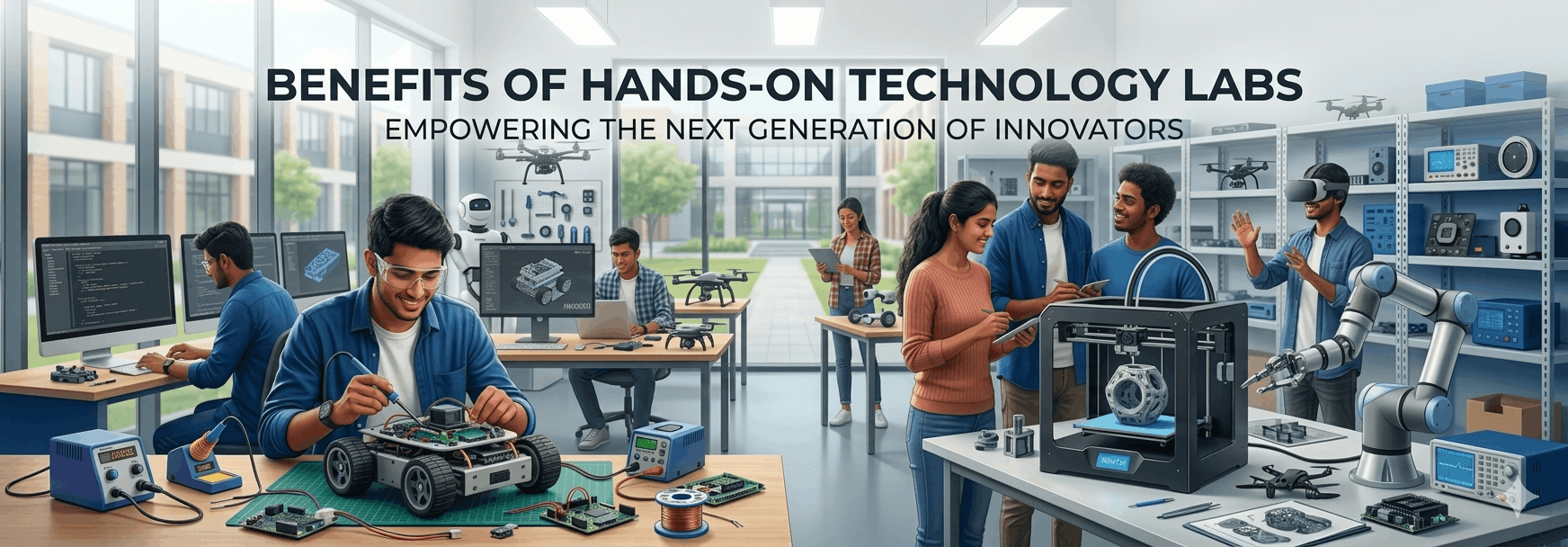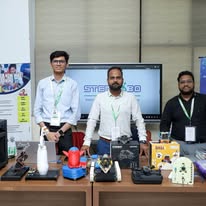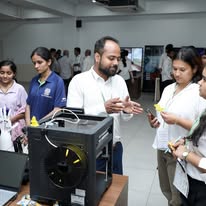
Walk into any leading engineering institution today and you will notice something the average college still lacks: a dedicated space where students stop being passive recipients of knowledge and start becoming active creators of it. A space buzzing with robotics arms, AI workstations, IoT prototypes, and the kind of industry-grade equipment that bridges the dangerous gap between classroom theory and real-world engineering practice.
That space is a Center of Excellence (CoE) Lab – and in 2026, it is no longer a luxury reserved for IITs and NITs. It has become an institutional imperative.
Whether you are a principal, a department head, a faculty member, or a college management professional, this comprehensive guide will walk you through every dimension of planning, designing, funding, and operating a world-class Center of Excellence Lab in your engineering college. From defining the right specialization to meeting AICTE guidelines, from sourcing industry partnerships to measuring outcomes – this is the most complete resource on the subject you will find.
“Engineering colleges that invest in Center of Excellence Labs consistently report higher campus placement rates, stronger industry partnerships, and significantly better student project outcomes than peers who rely on conventional laboratory setups.”
1. What Is a Center of Excellence Lab? (And Why Every Engineering College Needs One)
A Center of Excellence Lab in an engineering college is a specialized, industry-aligned facility focused on a particular technology domain – such as Artificial Intelligence, Robotics, VLSI Design, Cybersecurity, Embedded Systems, IoT, or Advanced Manufacturing. Unlike conventional departmental labs that teach standard syllabus experiments, a CoE Lab is built around deep, applied, industry-relevant learning.
It serves multiple interconnected purposes:
- Advanced Student Training: Students gain hands-on exposure to cutting-edge tools, platforms, and methodologies that industry actually uses.
- Applied Research: Faculty and students collaborate on sponsored research projects, publications, and patent filings.
- Industry Collaboration Hub: Companies use CoE Labs for joint development projects, product testing, and talent scouting.
- Skill Development and Certification: Students earn industry-recognized certifications that dramatically improve employability.
- Startup Incubation: Many CoE Labs serve as the launching pad for student and faculty startups.
The difference between a regular lab and a CoE Lab is the difference between learning to write code on a blackboard and building and deploying an actual machine learning model on cloud infrastructure. One prepares students for exams. The other prepares them for careers.
The Growing Demand for Engineering CoE Labs in India and Globally
The demand signal from industry is deafening. According to the National Association of Software and Service Companies (NASSCOM), India needs to reskill approximately 4 million technology professionals every year to keep pace with emerging technology adoption. Engineering colleges sit at the front line of this challenge.
Regulatory bodies are responding. AICTE’s Model Curriculum 2.0 explicitly encourages institutions to develop Centers of Excellence tied to emerging technology domains. The National Education Policy 2020 calls for experiential learning, industry immersion, and multidisciplinary research – all of which a well-designed CoE Lab directly enables.
Globally, the trend is identical. MIT’s labs, Stanford’s design school, and Singapore’s polytechnics have long demonstrated that industry-integrated CoE environments produce graduates who are not just more employable but more innovative. Replicating this model across engineering colleges at scale is one of the most high-leverage investments a college can make.
2. Choosing the Right Domain for Your CoE Lab
The first and arguably most consequential decision in setting up a Center of Excellence Lab is choosing the right technology domain. Get this right and everything that follows becomes easier – industry partners come forward, faculty get energized, students get placed, and grants flow in. Get it wrong and you have a room full of expensive equipment that nobody uses.
How to Evaluate and Select the Ideal CoE Domain
Assess Your Existing Faculty Strengths
A CoE Lab without strong faculty expertise at its core is unsustainable. Before choosing a domain, conduct an honest audit of your faculty’s research interests, industry experience, publication track record, and willingness to dedicate significant time to the lab. The best CoE domains are ones where you have at least two or three genuinely passionate faculty champions.
Map to Regional and National Industry Demand
Research the dominant industries in your region and the technology skills they are currently struggling to hire for. If your college is in Pune, automotive and manufacturing automation expertise is gold. In Bengaluru or Hyderabad, AI, data engineering, and cloud architecture dominate. In Chennai, semiconductor and VLSI design skills are in chronic short supply. Align your CoE domain with genuine, local hiring demand.
Evaluate Long-Term Relevance
Some technology domains are hot today but will be commoditized in three years. Choose domains with at least a 7-10 year horizon of relevance. In 2026, strong long-term CoE domains include: Artificial Intelligence and Machine Learning, Robotics and Automation, Cybersecurity, VLSI and Semiconductor Design, Electric Vehicle Technology, Quantum Computing (early-stage), and Biomedical Engineering.
Consider Infrastructure and Budget Fit
Be realistic about your capital budget. A Robotics CoE requires significant investment in robotic arms, simulation software, and sensor arrays. An AI/ML CoE can be built at a fraction of the cost using GPU workstations and cloud platforms. Match your domain ambition to your financial reality, and plan a phased infrastructure buildout accordingly.
Most In-Demand CoE Lab Domains for Engineering Colleges in 2026
- AI & Machine Learning CoE Lab: Covering deep learning, NLP, computer vision, MLOps, and GenAI applications. Extremely high industry demand and relatively capital-efficient to set up.
- Robotics & Automation CoE Lab: Industrial robotics, collaborative robots (cobots), robotic process automation, and autonomous systems.
- IoT & Embedded Systems CoE Lab: Connected devices, edge computing, firmware development, and industrial IoT applications.
- Cybersecurity CoE Lab: Network security, ethical hacking, security operations center (SOC) simulation, and digital forensics.
- VLSI & Semiconductor Design CoE Lab: Chip design, FPGA prototyping, EDA tools, and verification – critically important given the global semiconductor push.
- Electric Vehicle & Clean Energy CoE Lab: EV powertrain, battery management systems, charging infrastructure, and renewable energy integration.
- AR/VR & Digital Twins CoE Lab: Extended reality development, simulation, and digital twin engineering for manufacturing and infrastructure.
3. Planning the CoE Lab: Infrastructure, Space, and Equipment
Once you have locked in the domain, the real planning work begins. A well-designed CoE Lab is not just a collection of machines in a room. It is a carefully engineered learning environment that fosters collaboration, deep work, experimentation, and iteration.
Space Design Principles for a High-Impact CoE Lab
The physical design of your CoE Lab communicates your ambitions before a single student walks in. Here are the design principles that distinguish world-class CoE Labs from ordinary ones:
- Zoned Learning Environments: Divide the space into distinct zones – a lecture/briefing area for structured instruction, an open maker space for hands-on project work, a dedicated hardware area for equipment-intensive experiments, and a quieter research corner for reading and documentation.
- Flexible Furniture and Modular Workstations: Fixed rows of desks belong in classrooms, not CoE Labs. Use movable workbenches, modular storage, and reconfigurable seating that allows the space to adapt to different activity types.
- Visible Work in Progress: Install whiteboards, pin-up walls, and display screens to showcase student projects, timelines, and results. Visibility creates accountability and inspires ambition.
- Industry-Standard Ambiance: Design the lab to feel like a technology company’s R&D center, not a government institution. This psychological framing matters more than most administrators realize.
- Proper Power and Network Infrastructure: Ensure adequate three-phase power supply for high-draw equipment, UPS backup, high-speed wired and wireless networking, and sufficient ventilation for heat-generating hardware.
Minimum Viable Equipment List by Domain
For an AI & Robotics CoE Lab
- High-performance GPU workstations (NVIDIA RTX or A-series) – minimum 8 units
- Robotic arms (e.g., Universal Robots UR series, Doosan, or Fanuc collaborative robots)
- Vision systems: stereo cameras, depth sensors (Intel RealSense, ZED), and LIDAR units
- Edge AI hardware: NVIDIA Jetson AGX Orin or Xavier developer kits
- Drone platforms for aerial robotics experimentation
- Large interactive displays and visualization screens
- Software licenses: ROS2, MATLAB Robotics Toolbox, PyTorch, TensorFlow, CUDA toolkit
- Cloud platform access: AWS, GCP, or Azure with institutional credits
For a Cybersecurity CoE Lab
- Isolated network environment (air-gapped for penetration testing exercises)
- SOC simulation workstations with SIEM tools (Splunk, IBM QRadar)
- Cyber range platforms (RangeForce, Cyberbit, or open-source alternatives)
- Hardware security modules and IoT devices for vulnerability research
- Industry tools: Metasploit, Wireshark, Burp Suite, Nessus, Kali Linux environments
For a VLSI & Semiconductor Design CoE Lab
- EDA software suites: Cadence Virtuoso, Synopsys Design Compiler, Mentor Graphics
- FPGA development boards: Xilinx Ultrascale+, Intel Cyclone series
- Oscilloscopes, logic analyzers, and mixed-signal test equipment
- PCB design and fabrication tools: Altium Designer or KiCad workstations
- Server-grade workstations for compute-intensive simulation runs
Pro Tip: Rather than trying to buy everything on day one, publish a phased equipment roadmap that spans three years. Present Phase 1 as the minimum viable CoE, and tie Phase 2 and Phase 3 additions to measurable outcomes – student certifications, research publications, industry MOUs signed. This makes budget approvals significantly easier.
4. Funding Your CoE Lab: Sources, Strategies, and Grant Opportunities
Funding is often cited as the biggest barrier to setting up a CoE Lab. In reality, with the right strategy, a well-scoped CoE can be funded through a combination of sources that distributes the financial risk and builds institutional credibility simultaneously.
Primary Funding Sources for Engineering College CoE Labs
1. Government Grants and Schemes
The Indian government offers several schemes specifically designed to support infrastructure development and technology labs in engineering colleges:
- AICTE Research and Innovation Scheme (ARIES): Provides grants for applied research infrastructure, equipment, and faculty development.
- DST-FIST (Fund for Improvement of S&T Infrastructure): Covers major equipment procurement for research-active departments.
- RUSA (Rashtriya Uchchatar Shiksha Abhiyan): State-level grants for infrastructure and quality improvement in higher education institutions.
- Ministry of Electronics and IT (MeitY) Schemes: Particularly relevant for CoE Labs in electronics, cybersecurity, and semiconductor domains.
- National Mission on Education through ICT (NMEICT): Supports digital infrastructure and e-learning lab development.
Internationally, grants from the European Horizon program, NSF (for US-affiliated institutions), and bilateral research funding programs between India and countries like Japan, Germany, and South Korea are worth exploring.
2. Industry Partnerships and Sponsored Labs
This is, without question, the most powerful and sustainable CoE funding model. Technology companies actively seek academic partnerships because they provide access to research talent, pre-commercial technology testing, and a pipeline of trained recruits.
Companies like Siemens, Bosch, Honeywell, Texas Instruments, Qualcomm, Intel, NVIDIA, Cisco, IBM, SAP, and dozens of others have formal academic partnership programs in India. These programs typically offer:
- Equipment donations or deep discounts on hardware and software
- Co-branded lab naming rights (which the company values for brand visibility)
- Faculty training and certification support
- Curriculum content, case studies, and real project briefs
- Internship and placement pipelines for lab students
- Joint research funding for defined problem statements
The key to securing industry partnerships is specificity. Do not approach companies with a generic request for support. Come with a detailed proposal that outlines what the CoE will do, who will use it, what problems it will solve, and specifically what you are asking the company to contribute.
3. Alumni Contributions and CSR Funding
Your alumni are among the most underutilized funding sources in Indian higher education. Successful engineering alumni – especially those who have built careers in technology companies, founded startups, or reached senior positions in corporates – are often deeply motivated to give back, provided you make it easy for them and give them visibility for their contributions.
CSR (Corporate Social Responsibility) funding under Section 135 of the Companies Act 2013 is another significant avenue. Education is an eligible CSR activity, and many companies allocate substantial CSR budgets to engineering education infrastructure. Build a structured CSR proposal template and actively pitch to companies in your geographic area.
4. Fee-Based Revenue Generation
A CoE Lab does not have to be a pure cost center. With the right programming, it can generate revenue that offsets operational costs:
- Paid short-term courses and certification programs for working professionals
- Weekend bootcamps for engineering students from other colleges
- Contract testing and prototyping services for local industry
- Hosting competitive events, hackathons, and corporate workshops
- Licensing proprietary training content developed by the lab
5. Building Industry Partnerships: The Lifeblood of a Successful CoE Lab
If funding is the body of a CoE Lab, industry partnerships are its nervous system. They bring relevance, resources, real-world problems, and ultimately, jobs. Building and maintaining strong industry partnerships is not a one-time activity – it is an ongoing relationship management commitment.
The Partnership Value Exchange
Successful industry-academia partnerships work because both sides get something genuinely valuable. Understanding this clearly will help you pitch more effectively and structure partnerships that last.
What colleges offer: Research capabilities, student talent, neutral testing environments, geographic presence, and brand association with academic credibility.
What industry gets: Pre-trained recruits, co-developed intellectual property, applied research outputs, visibility as an employer of choice, and CSR credit.
The most durable partnerships are structured so both sides feel they are getting more than they are giving. Design your partnership proposals with this asymmetry in mind.
How to Approach and Secure Industry Partners
- Start with alumni connections: Your most accessible industry partners are companies where your alumni are in leadership positions. They already believe in your institution.
- Target companies with local presence first: Companies with offices or manufacturing plants in your city or region are more likely to engage meaningfully than distant headquarters.
- Attend industry conferences and tech events: Faculty who are visible in industry circles attract partnership interest organically.
- Develop a compelling partnership prospectus: A professional, well-designed document that clearly articulates the CoE’s vision, capabilities, student outcomes, and partnership tiers.
- Offer pilot engagements: Propose a low-commitment pilot – a guest lecture series, a student project sponsorship, or a one-day campus visit – before asking for large commitments.
- Deliver and document every commitment: Industry partners renew and expand relationships when they see clear evidence that their investment created value. Send quarterly reports, invite partners to student demos, and share placement data religiously.
Structuring Formal Industry MOUs for CoE Labs
Every significant industry partnership should be formalized through a Memorandum of Understanding (MOU). A well-drafted CoE MOU should specify:
- The scope of the partnership and specific activities covered
- Financial contributions and equipment commitments from the industry partner
- Faculty development and training commitments
- Curriculum co-development responsibilities
- Intellectual property ownership and publication rights for joint research
- Student internship and placement commitments (with realistic, measurable numbers)
- Review and renewal timelines
Involve your institution’s legal counsel in drafting MOUs, particularly around IP clauses. Ambiguity in intellectual property ownership has derailed more than a few otherwise promising partnerships.
6. AICTE Compliance, Accreditation, and Regulatory Considerations
Setting up a CoE Lab in an AICTE-approved engineering college requires navigating a regulatory environment that, while sometimes complex, is increasingly supportive of innovation infrastructure. Understanding the compliance landscape upfront will save you significant time and frustration.
AICTE Guidelines for Centers of Excellence
AICTE’s approval hand book and associated circulars outline the requirements for CoE Labs in affiliated engineering colleges. Key compliance areas include:
- Minimum Space Requirements: AICTE specifies minimum carpet area requirements for specialized labs. Ensure your CoE space meets or exceeds these norms, and document the measurements clearly in your approval applications.
- Equipment Adequacy: AICTE reviews the adequacy of equipment relative to student strength and program scope. Maintain an updated equipment register with purchase dates, current conditions, and utilization records.
- Faculty Qualification Standards: Faculty overseeing CoE Labs should meet AICTE’s minimum qualification requirements for the relevant domain. Additional industry certifications strengthen your case significantly.
- Safety Standards Compliance: Particularly relevant for Robotics, High Voltage, and Chemical Engineering CoE Labs. Ensure fire safety systems, emergency shutdown procedures, and personal protective equipment are in place and documented.
NBA and NAAC Accreditation Alignment
A well-operated CoE Lab is a powerful asset in both NBA (National Board of Accreditation) and NAAC (National Assessment and Accreditation Council) accreditation processes.
For NBA accreditation, CoE Labs directly contribute to Program Outcome (PO) attainment evidence, particularly POs related to design, modern tool usage, research capability, and lifelong learning. Document student projects, outcomes, and competency demonstrations meticulously for your Self-Assessment Report (SAR).
For NAAC, CoE Labs contribute to multiple criteria including Research, Innovations and Extension (Criterion III) and Infrastructure and Learning Resources (Criterion IV). Maintain a living repository of research outputs, patents filed, publications, industry collaborations, and student achievements linked to the CoE.
7. Designing the Curriculum and Learning Programs
The physical infrastructure of your CoE Lab is only as valuable as the learning programs running inside it. Curriculum design is where the real transformation happens – and it requires a fundamentally different approach from traditional course design.
Principles of CoE Lab Curriculum Design
- Project-Based Learning at the Core: Every module in the CoE should culminate in a deliverable – a working prototype, a deployed application, a research report, or a functional system. Theory without application is not CoE-worthy curriculum.
- Industry-Aligned Skill Mapping: Map every learning activity to specific skills that industry hiring managers are actively seeking. Use job description analysis and industry advisory board input to keep this mapping current.
- Certification Pathways: Partner with certification bodies – NVIDIA Deep Learning Institute, Cisco Networking Academy, Red Hat Academy, AWS Academy, MATLAB Certifications, and others – to offer students credentials that are independently verifiable and globally recognized.
- Progressive Complexity: Structure your curriculum in clearly defined tiers – Foundation, Intermediate, and Advanced – so students can enter at their current skill level and see a clear growth pathway.
- Cross-Disciplinary Projects: Some of the most innovative CoE work happens at the intersection of disciplines. Create projects that require students from different engineering streams to collaborate – a mechanical engineer and a computer science student co-designing an autonomous guided vehicle, for example.
Types of Programs to Run in a CoE Lab
- Regular semester-integrated electives (credit-bearing courses tied to the CoE domain)
- Intensive short courses and bootcamps (1-4 weeks) during semester breaks
- Final year project supervision and mentoring programs
- PhD and research scholar program support
- Faculty development programs (FDPs) for upskilling teaching staff
- Industry certification preparation courses
- Competitive event training (hackathons, smart India hackathon, robotics competitions)
- Continuing education programs for working professionals
“The most successful CoE Labs we’ve seen run at least two intensive short programs every semester alongside regular coursework. The students who go through intensive formats consistently outperform their peers in placements and project quality.”
8. Staffing, Faculty Development, and Managing the CoE
The organizational dimension of a CoE Lab is as important as its physical and curricular dimensions. A CoE without clear ownership, dedicated staffing, and a culture of continuous improvement will gradually drift toward irrelevance – no matter how impressive its initial launch.
Key Roles in a CoE Lab Organization
- CoE Director / Faculty Coordinator: A senior, respected faculty member with genuine domain expertise and strong administrative skills. The CoE Director owns the vision, manages partnerships, oversees budget, and represents the lab to management and accreditation bodies. This cannot be a ceremonial role – it requires real time commitment.
- Domain Expert Faculty: Two to three faculty members with deep expertise in the CoE domain. Ideally, at least one should have significant industry experience, not just academic credentials.
- Lab Manager / Technical Superintendent: Responsible for equipment maintenance, inventory management, lab scheduling, safety compliance, and day-to-day operations. Often the most undervalued role in a CoE – find someone technically competent and operationally reliable.
- Research Associates / Teaching Assistants: Advanced students (final year UG or postgraduate) who have demonstrated excellence in the domain. They extend the CoE’s instructional capacity while gaining valuable experience themselves.
- Industry Liaison Officer: In larger CoE setups, a dedicated person for managing industry relationships, coordinating MOU activities, and tracking partnership deliverables makes a measurable difference in partnership quality.
Faculty Development: The Non-Negotiable Investment
A CoE Lab can only teach what its faculty know. In fast-moving domains like AI, Robotics, and Cybersecurity, last year’s knowledge is genuinely insufficient. Build a structured faculty development program that includes:
- Annual mandatory participation in domain-specific professional development programs
- Support for faculty to attend national and international conferences
- Industry sabbatical programs where faculty spend one semester working in a relevant company
- Internal knowledge-sharing sessions where faculty who attend training teach their peers
- Financial incentives tied to certifications earned, publications produced, and patents filed
9. Measuring Success: KPIs and Outcomes for Your CoE Lab
If you cannot measure it, you cannot improve it – and you cannot defend the budget for it. Establishing a clear metrics framework before your CoE launches gives you the data you need to demonstrate value, justify investment, and continuously improve.
Essential KPIs for Engineering College CoE Labs
Student Outcome Metrics
- Number of students trained per semester (target 100% utilization of allocated capacity)
- Industry certification pass rates (benchmark against national averages)
- Student placement rate and average compensation premium for CoE-trained students vs. non-CoE students
- Number of student projects progressing to patents, publications, or startup incorporation
- Student satisfaction scores from structured feedback surveys
Research and Innovation Metrics
- Number of research publications in peer-reviewed journals (with impact factor tracking)
- Patents filed and patents granted
- Funded research projects active at any given time
- Prototypes developed and successfully demonstrated
- Awards won in national and international competitions
Industry Engagement Metrics
- Number of active industry MOUs (track not just signed MOUs but actively engaged ones)
- Cumulative value of industry contributions (equipment, cash, faculty training, internships)
- Number of real industry problem statements addressed each year
- Company visits, campus drives, and pre-placement offers originating from CoE relationships
Operational Metrics
- Lab utilization rate (hours of active use per week as a percentage of available hours)
- Equipment uptime and maintenance responsiveness
- Faculty development hours logged per faculty member
- Revenue generated from paid programs and services
Present these KPIs in a clear, visual dashboard that is shared with management quarterly and with accreditation bodies annually. Transparency builds trust and attracts continued investment.
10. Common Mistakes Engineering Colleges Make When Setting Up CoE Labs
Learning from others’ expensive mistakes is a fundamental skill in engineering. Here are the most common CoE Lab failures – and how to avoid them:
- Buying Equipment Before Building the Program: Colleges often spend their entire budget on impressive hardware and then realize they have no curriculum, no trained faculty, and no students motivated to use it. Always program first, procure second.
- No Dedicated Faculty Ownership: A CoE that is “everyone’s responsibility” quickly becomes no one’s responsibility. Assign clear, accountable ownership with protected time and appropriate incentives.
- Treating the CoE as a One-Time Infrastructure Project: A CoE Lab is a living organization, not a construction project. Budget explicitly for ongoing operations, maintenance, software renewals, and faculty development – year after year.
- Ignoring Student Awareness and Onboarding: Even the best CoE Lab underperforms if students do not know what it offers, how to access it, or why it matters for their careers. Invest in robust onboarding, marketing within the college, and peer mentoring programs.
- Weak Industry Relationships: Signing MOUs is not the same as building partnerships. An MOU that exists only on paper is worse than no MOU because it creates false confidence. Assign someone to actively manage every partnership with regular check-ins and deliverable tracking.
- Neglecting Documentation and Knowledge Management: The institutional knowledge built in a CoE – project templates, research findings, equipment protocols, course materials – should be systematically documented. When the founding faculty move on, the CoE’s accumulated wisdom should remain.
Conclusion: Your CoE Lab Is a Long-Term Commitment to Student Excellence
Setting up a Center of Excellence Lab in your engineering college is one of the most impactful investments your institution can make – not just for the rankings and accreditation scores it generates, but for the fundamental difference it makes in the lives of your students.
The students who pass through a well-run CoE Lab leave with something that no examination can grant them: the confidence that they can build real things, solve real problems, and contribute meaningfully to industries that are reshaping the world. That confidence is the most employable quality a graduate can have.
The road to a world-class CoE Lab is not short. It requires patient institutional commitment, a willingness to invest in people as much as in equipment, and the humility to keep learning and adapting as technology evolves. But the colleges that make this commitment consistently and systematically are the ones that define engineering education excellence for their region and their era.
Start planning your CoE Lab today. Your next batch of graduates – and the industries that will hire them – are counting on it.