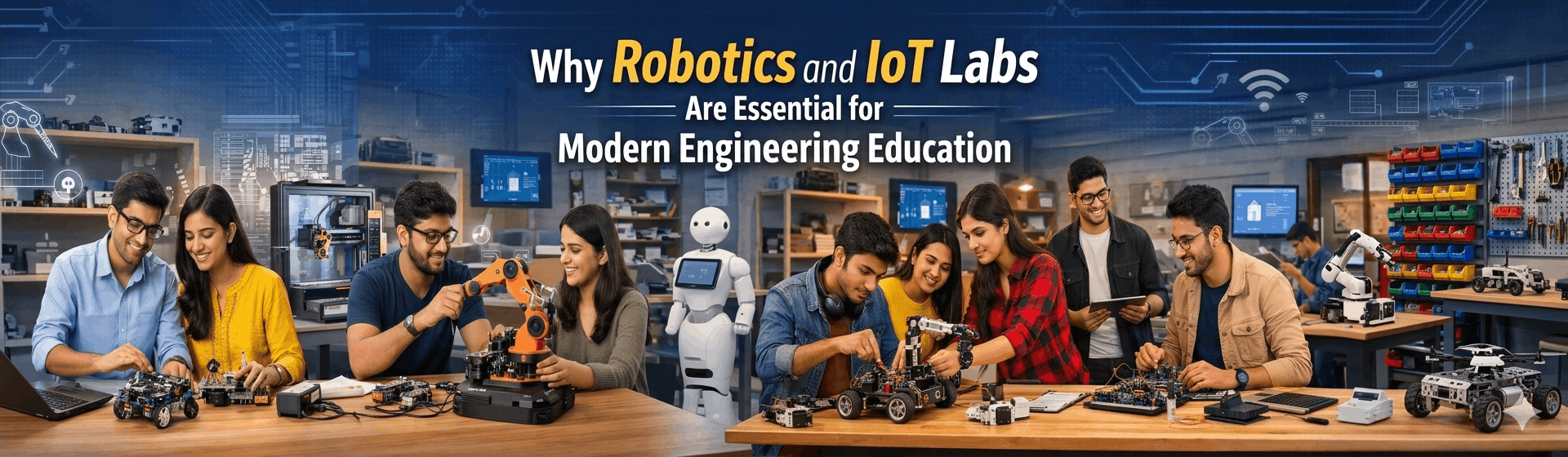
The Widening Gap Between Classroom and Industry
Engineering graduates have long faced a paradox: four years of rigorous academic training, yet arriving at their first job without the practical skills employers actually need. This gap has grown wider with the rapid rise of Industry 4.0 an era defined by smart factories, autonomous systems, and billions of internet-connected devices working in seamless concert.
A 2023 NASSCOM report revealed that fewer than 25% of engineering graduates in India are considered “industry-ready” by leading technology employers. The root cause is not lack of intelligence or effort it is lack of exposure. When students spend their formative years only solving equations on paper, they miss the tactile, iterative, failure-rich experience that builds real engineering intuition.
This is precisely why Robotics Lab Setup for Engineering Colleges and dedicated IoT Lab Setup for Colleges are no longer optional investments. They are the infrastructure of relevance the physical bridge between theory and professional competence.
What Robotics Education Actually Builds in Engineering Students
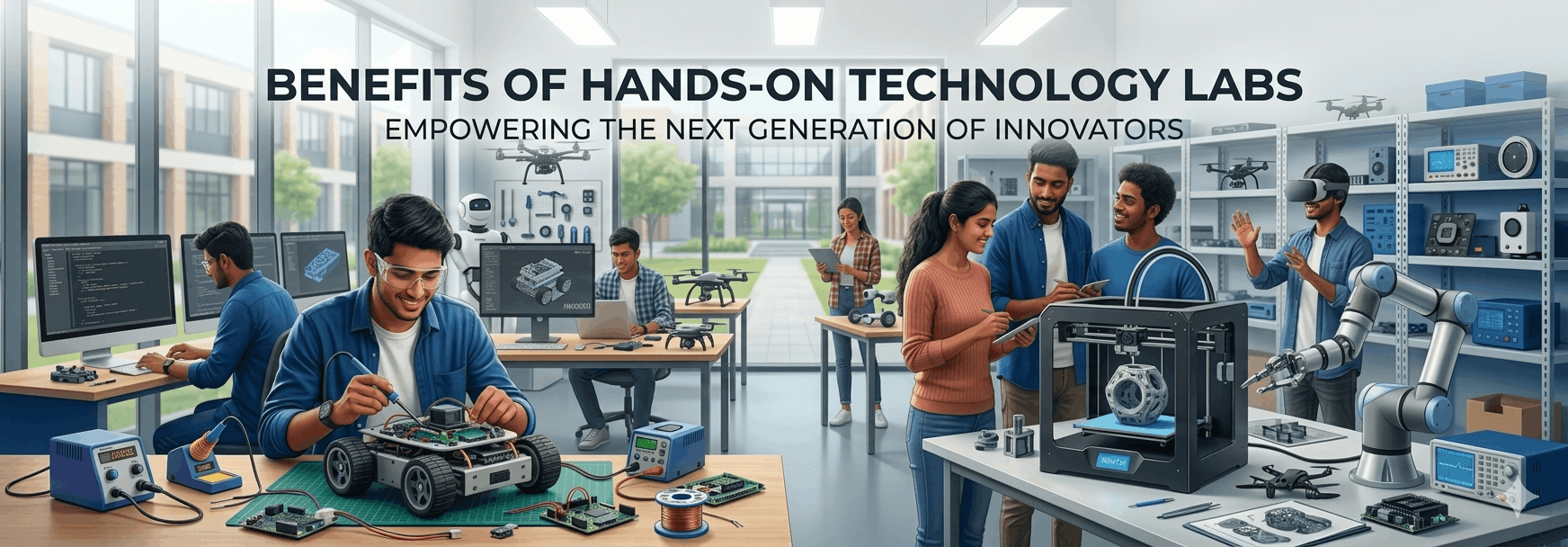
Robotics education in engineering colleges is far more than programming a mechanical arm to wave. A well-structured robotics curriculum teaches students to integrate disciplines mechanical design, electronics, control theory, embedded programming, and artificial intelligence into a single working system. This interdisciplinary nature is exactly what industry demands.
When a student designs a path-finding robot, they encounter real problems: sensor noise, motor drift, power management, real-time software constraints. These are not hypothetical challenges solved with a formula. They require debugging, creativity, iteration, and collaborative problem-solving. No textbook chapter can replicate the learning that comes from watching a robot fail, diagnosing why, and fixing it at 11 PM before a lab deadline.
The Engineering College Robotics Lab Benefits extend beyond technical skills. Students who work in robotics labs consistently demonstrate stronger project management abilities, clearer technical communication, and greater resilience in the face of ambiguous problems precisely the soft-skill shortfalls that employers most frequently cite in new hires.
Robotics does not just teach students how machines move it teaches them how engineers think: iteratively, collaboratively, and with a healthy respect for failure.
03 · The IoT Imperative
IoT Training Labs: Building the Engineers of a Connected World
The Internet of Things has transformed every sector agriculture, healthcare, logistics, manufacturing, energy, and urban infrastructure. By 2030, analysts project over 75 billion connected devices will be active globally. The engineers who design, deploy, and maintain these systems need more than theoretical knowledge of networking protocols. They need hands-on fluency.
An IoT Training Lab for Universities gives students a controlled environment to build real connected systems. Working with microcontrollers (like Arduino and Raspberry Pi), cloud platforms (AWS IoT, Azure IoT Hub), wireless communication protocols (MQTT, Zigbee, LoRa), and edge computing concepts, students move from passive learners to active builders. A student who has personally built a temperature-monitoring greenhouse system or a smart parking sensor network understands networking, data pipelines, and embedded constraints in a way no lecture can convey.
The best IoT Lab Setup for Colleges is modular by design it scales from simple sensor-to-cloud projects for first-year students all the way to complex multi-node industrial simulation for final-year engineers. This progression ensures students accumulate competency systematically, arriving at their capstone projects with genuine depth.
04 · Lab Design
What Makes a World-Class Robotics and IoT Lab
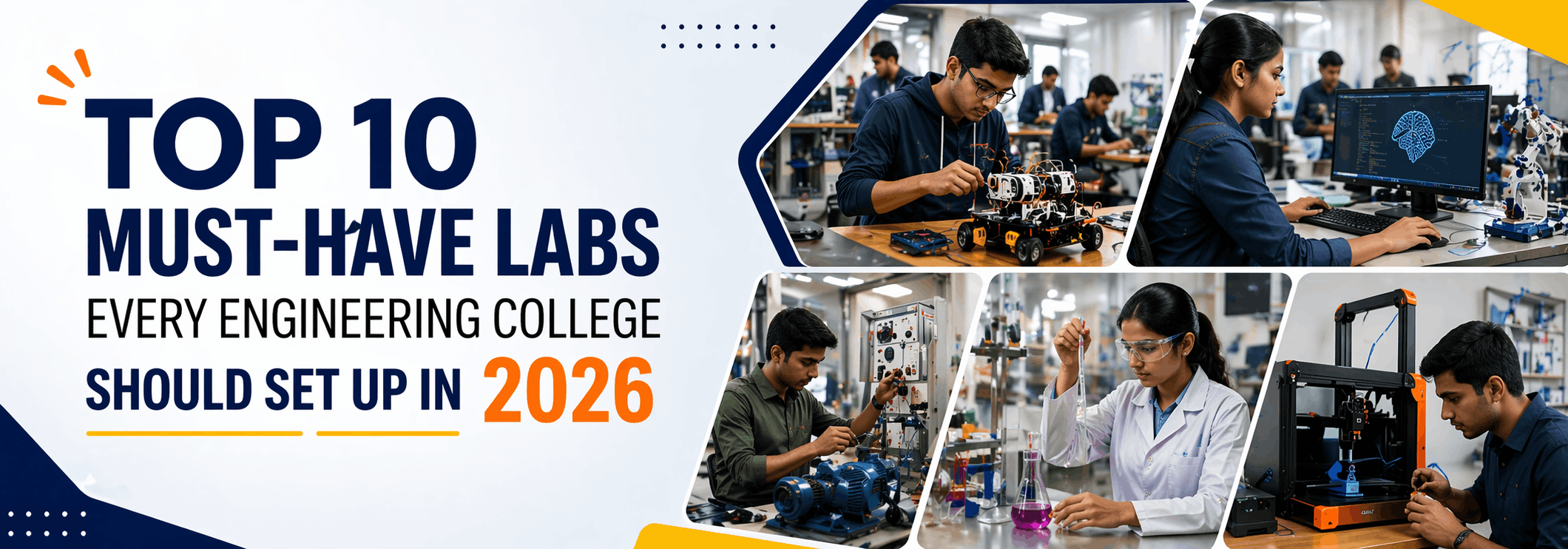
Not all labs are created equal. Many institutions invest in equipment that sits unused because the supporting curriculum and mentorship structures are absent. A truly effective Robotics and IoT Lab for Engineering Students is built around three pillars: equipment, curriculum integration, and industry linkage.
- Diverse robot platforms wheeled, robotic arms, drone, and humanoid to expose students to varied mechanical paradigms
- Embedded development boards and rapid prototyping tools for iterative hardware builds
- Cloud infrastructure access and real industry IoT platforms, not just simulated environments
- Dedicated project zones where teams can leave ongoing builds over days and weeks
- Mentors with active industry experience, not just academic credentials
- Industry challenge boards updated every semester with real-world problem statements
- Integration with coursework so lab hours count as academic progress, not extracurricular burden
- Open access hours beyond scheduled classes to reward intrinsic curiosity
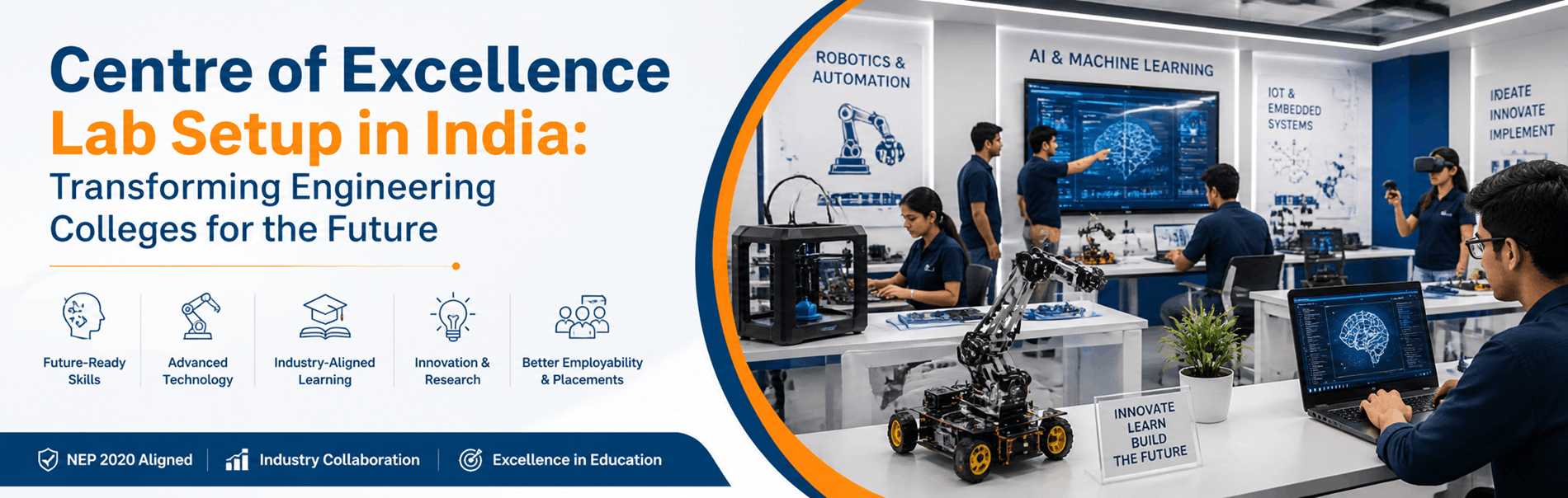
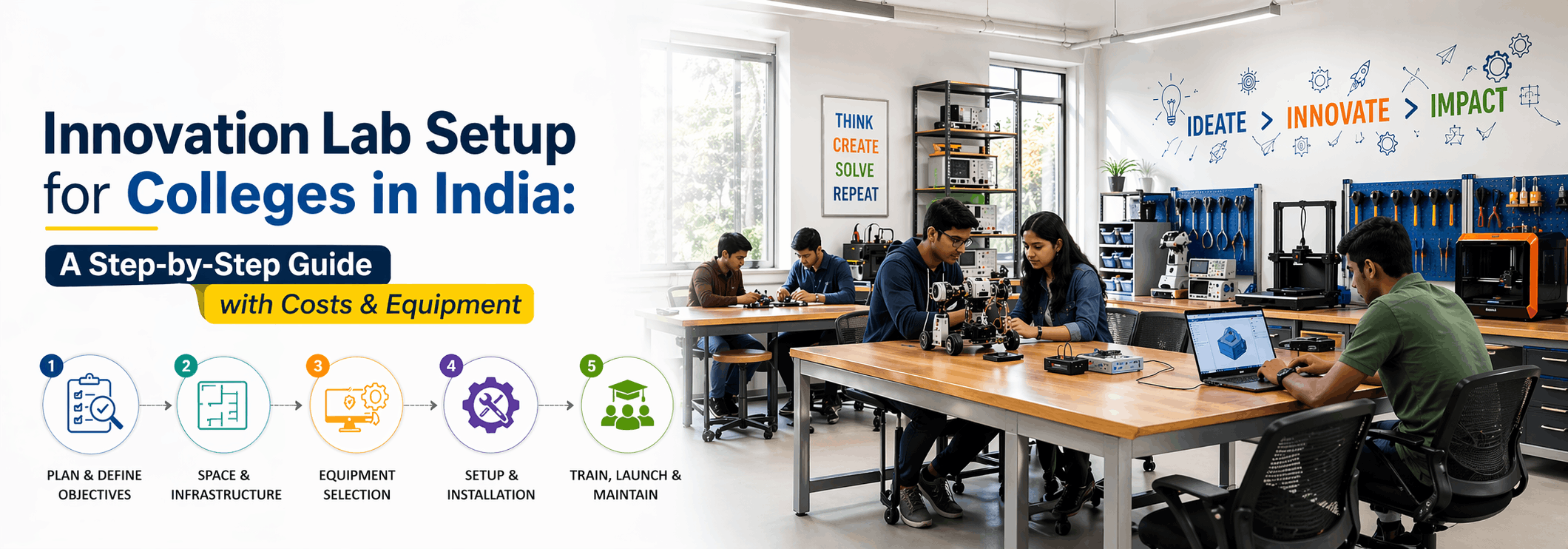
The physical design of the lab matters too. Open, reconfigurable spaces encourage collaboration. Whiteboards everywhere invite rapid sketching of ideas. Transparent storage of components signals abundance and trust. The best Future Technology Labs for Engineering Colleges feel less like classrooms and more like the R&D floors of technology companies because that is what they are preparing students to enter.
05 · Industry Readiness
From Campus Lab to Career: Building Industry-Ready Engineers
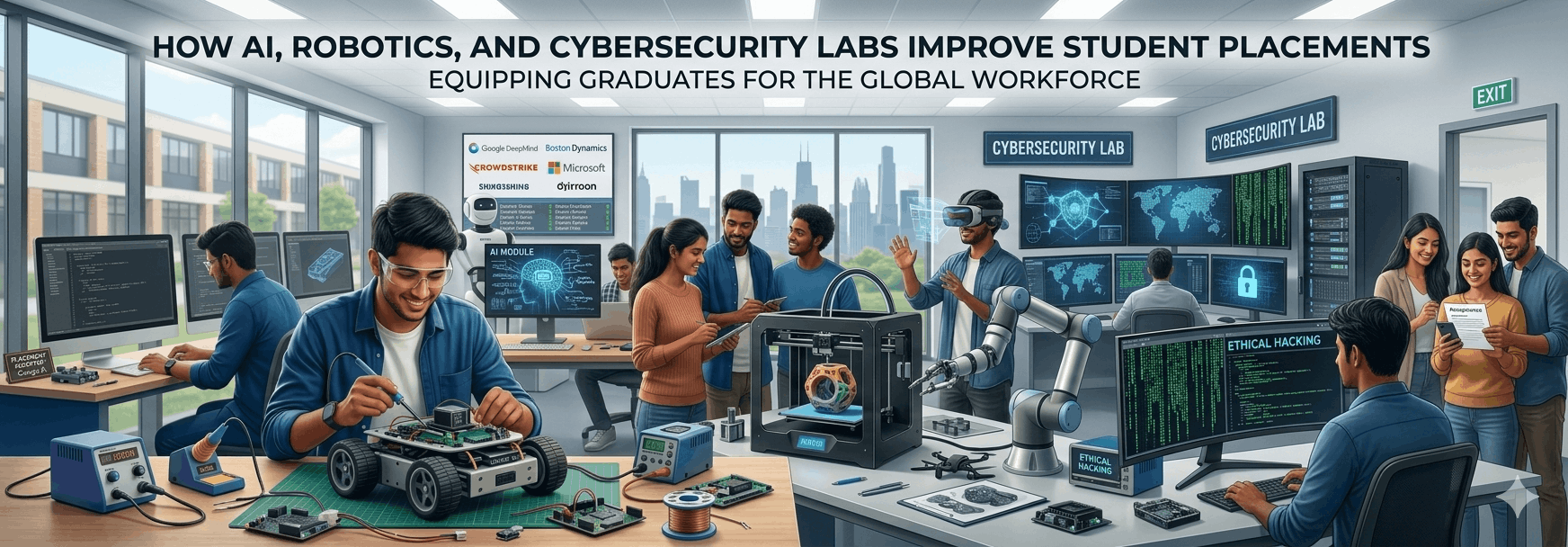
The ultimate measure of any lab investment is the quality of graduates it produces. Companies hiring from institutions with strong Robotics Lab Setup for Engineering Colleges consistently report a measurable difference: candidates who have worked in these environments require shorter onboarding times, ask better questions, and adapt more quickly to unfamiliar technology stacks.
Industry-Ready Skills for Engineering Students can be grouped into three categories that quality Robotics and IoT labs directly cultivate. The first is technical breadth comfort across hardware, software, networking, and data domains. The second is systems thinking the ability to see how individual components interact within a larger architecture, and to anticipate failure modes before they occur. The third is project fluency the ability to take an ambiguous problem statement, scope it into deliverable milestones, build iteratively, and communicate progress clearly.
Companies like Bosch, Siemens, ABB, and TCS have begun partnering directly with institutions that maintain robust lab facilities co-designing curriculum, funding equipment, and recruiting from these specific programs. For colleges, investing in these labs is not merely an educational decision; it is a strategic positioning decision in the intensely competitive landscape of placement outcomes and institutional reputation.
06 · The Bigger Picture
Future Technology Labs as National Infrastructure
India’s National Education Policy 2020 explicitly emphasizes experiential learning, multidisciplinary education, and industry integration. The establishment of Future Technology Labs for Engineering Colleges across the country aligns directly with this vision and with the national imperative to build a workforce capable of leading in semiconductors, aerospace, defense electronics, electric vehicles, and smart cities.
When viewed collectively, these labs represent a distributed national R&D network. A student in Coimbatore solving an agricultural IoT problem, another in Pune building an autonomous inspection drone, and a third in Bhubaneswar designing a smart water management system all of them, collectively, are building India’s technological future one prototype at a time.
The return on investment for colleges is clear: higher placement rates, stronger alumni networks, greater research output, and an identity that attracts both students and industry partners. The return for society is even larger: a generation of engineers who have genuinely built things, who understand how connected systems work at every layer, and who are equipped to solve the complex challenges of the next two decades.
Conclusion: Build the Lab, Build the Future
Engineering education has always been at its best when it is tied to making to the act of building something real that works, fails, and works again. Robotics and IoT labs are the modern expression of this foundational principle. They are where theory becomes intuition, where students become engineers, and where colleges fulfill their most important promise.
For institutions asking whether now is the right time to invest in a dedicated Robotics and IoT Lab for Engineering Students, the data, the industry signals, and the career outcomes of peer institutions all point to the same answer: the right time was five years ago. The second-best time is today.