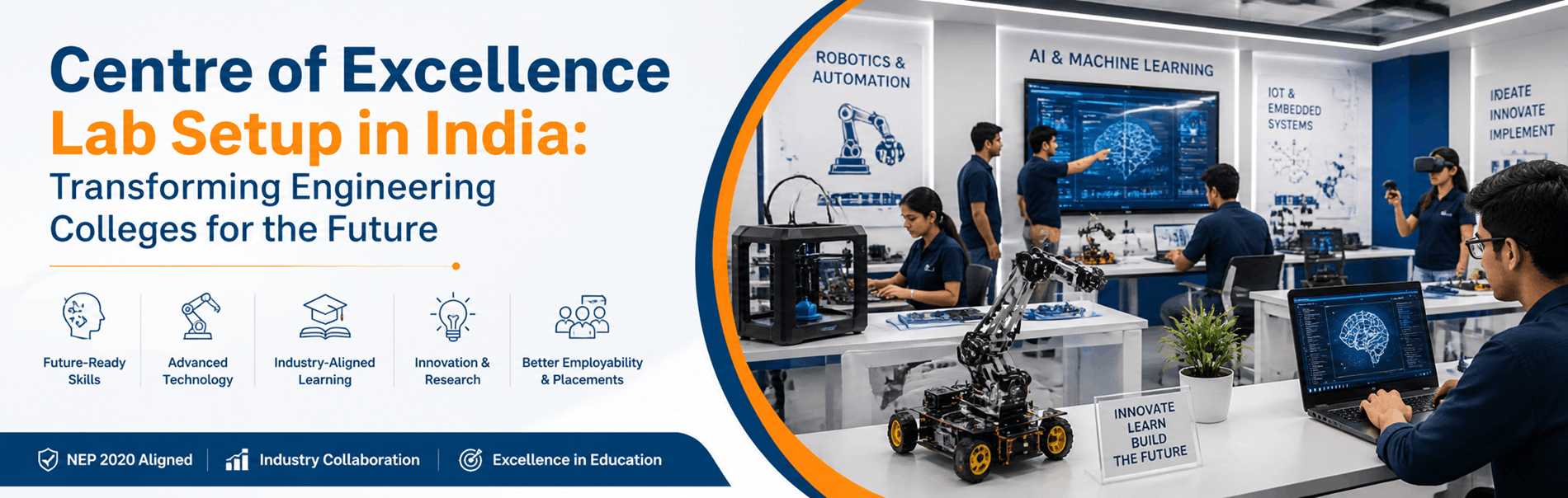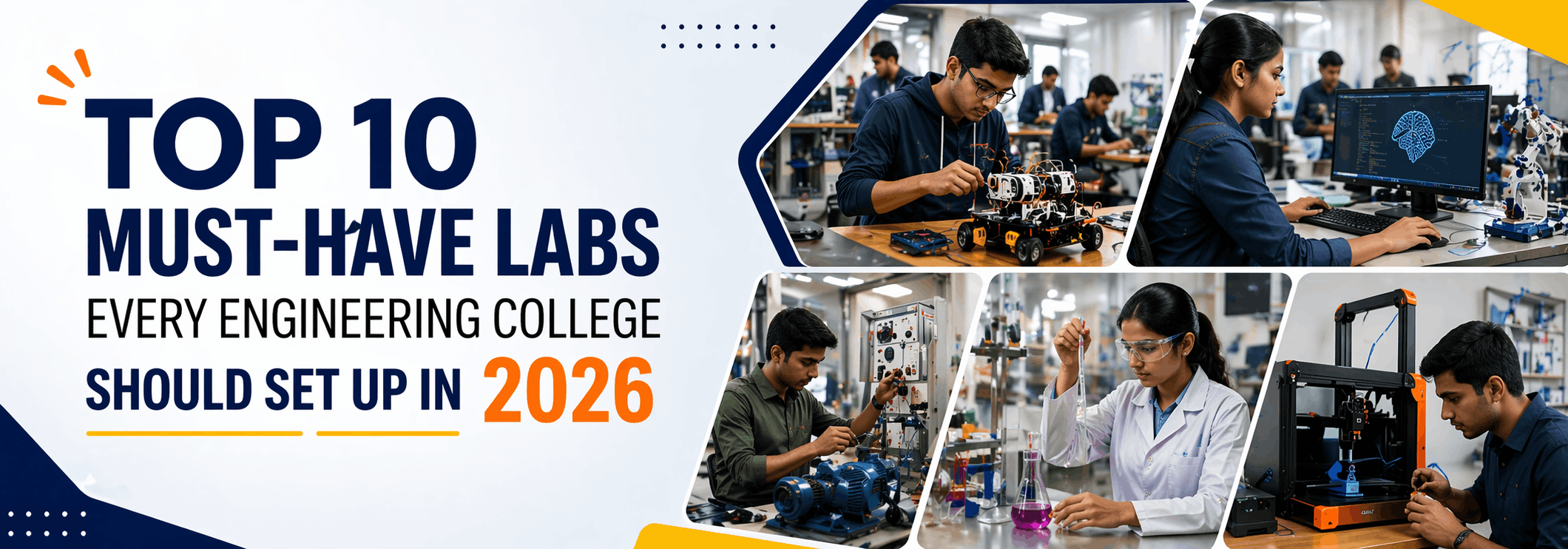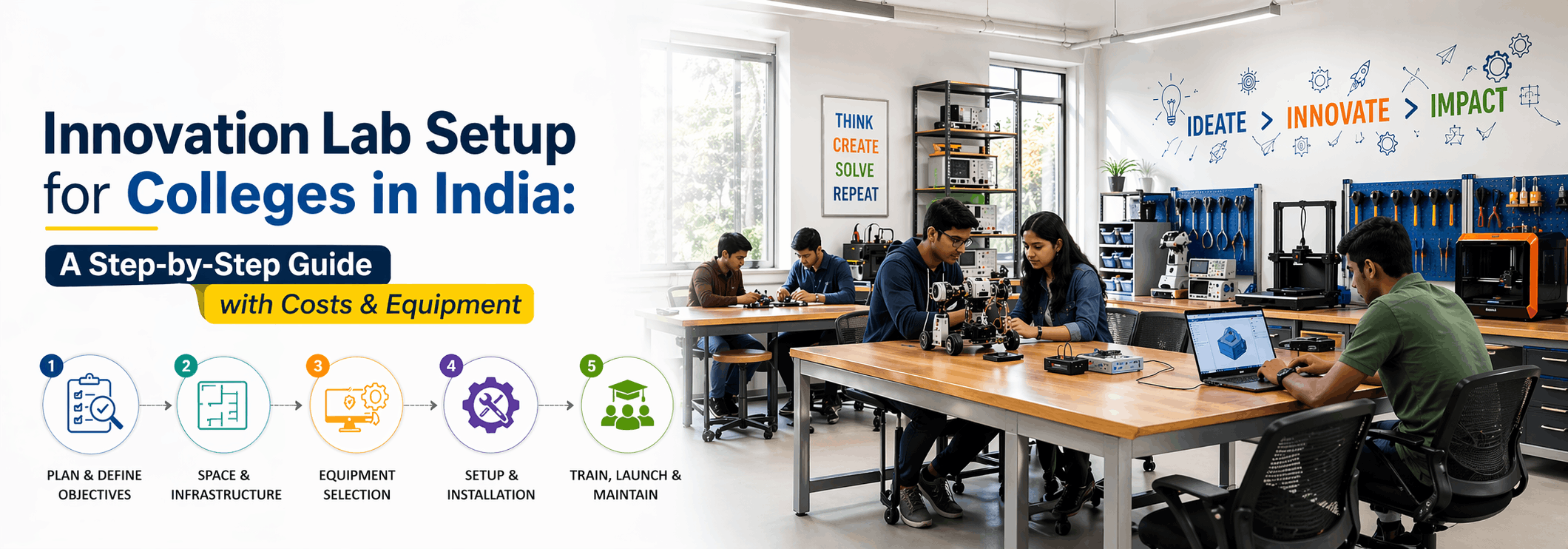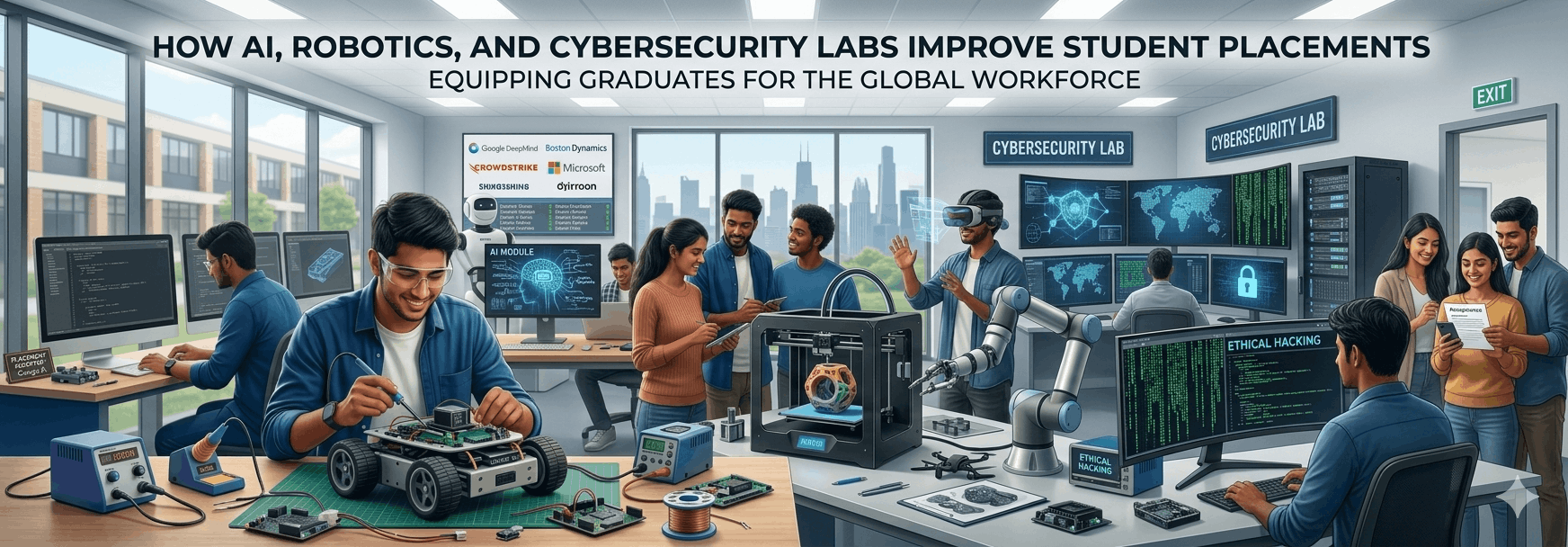
India’s higher education landscape is undergoing a profound transformation. As industries pivot toward Artificial Intelligence, Robotics, IoT, and Cloud Computing, the gap between what students learn in classrooms and what employers actually need has never been more visible. The question facing every college and university today is straightforward: how do we prepare students not just to graduate, but to truly excel in a fast-evolving world?
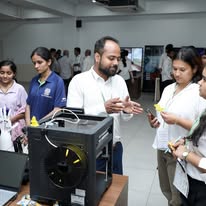
The answer lies in hands-on technology labs – purpose-built spaces where students stop being passive learners and start becoming active creators, problem-solvers, and innovators. At HexNBit, we have had the privilege of setting up state-of-the-art labs across institutions in India, and we have seen firsthand how these environments fundamentally change the trajectory of student outcomes. Here is a deep dive into why every college and university must prioritize hands-on technology labs.
1. Bridging the Gap Between Theory and Practice
One of the most persistent challenges in technical education is the chasm between theoretical knowledge and practical application. A student can memorize the principles of neural networks, but programming one to classify real-world data is an entirely different experience. Hands-on labs close this gap decisively.
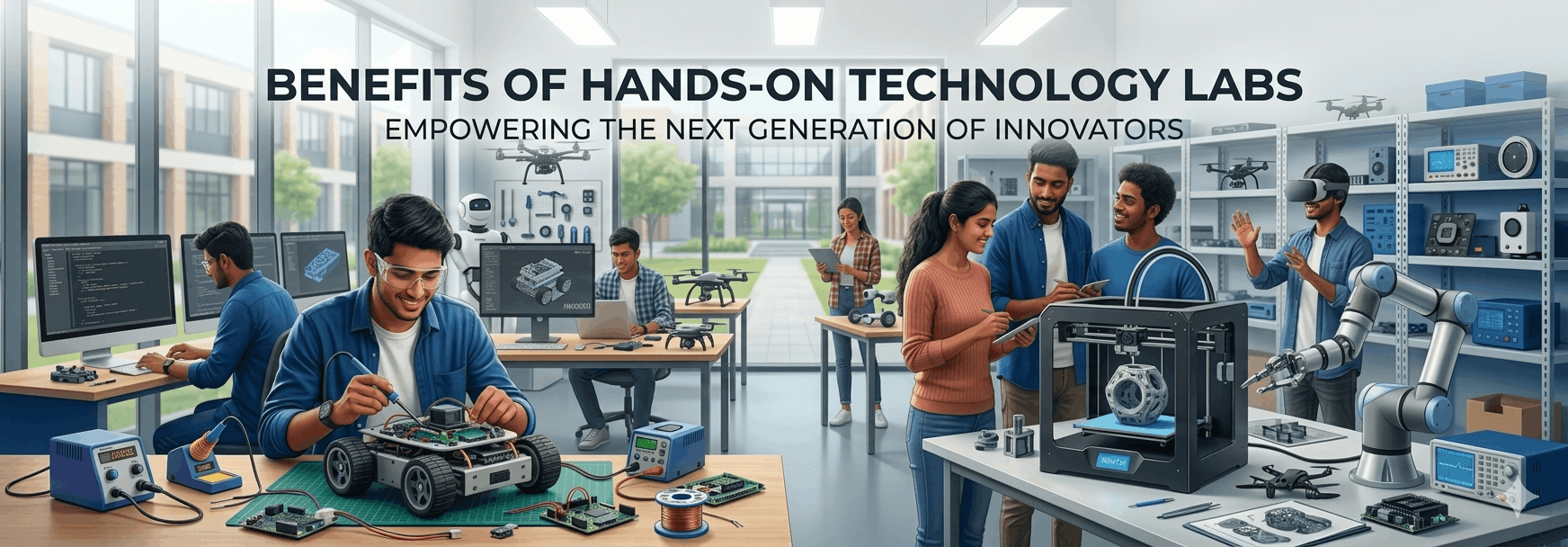
When students work inside an AI & Machine Learning Lab, they train models on live datasets, visualize outputs in real time, and iterate on failures – a process that no textbook chapter can replicate. Similarly, in a Robotics & IoT Lab, students wire circuits, debug sensors, and watch their code control physical hardware. These moments of tangible feedback accelerate understanding in ways that lectures simply cannot match.
Research consistently shows that experiential learning dramatically improves retention and comprehension. When students build, break, and rebuild, the learning becomes embedded – not memorized.
2. Developing Industry-Ready Skills Aligned with Industry 4.0
The global economy is firmly in the era of Industry 4.0, defined by the fusion of physical, digital, and biological systems. Employers are no longer satisfied with graduates who understand concepts in theory; they want professionals who can deploy a CI/CD pipeline, configure an IoT network, design a VLSI circuit, or launch a drone for precision agriculture on day one.
Hands-on technology labs are designed precisely to produce this kind of graduate. Institutions equipped with a DevOps & Cloud Lab give students real exposure to platforms like AWS, Azure, and Docker. A Cybersecurity Lab trains students to conduct ethical hacking exercises and build network defense strategies against simulated attacks. A VLSI & Semiconductor Lab takes students through actual chip design workflows.
This is the difference between a graduate who says, “I studied machine learning,” and one who says, “I’ve deployed three end-to-end ML models.” Hiring managers know which candidate they want.
3. Fostering Innovation, Entrepreneurship, and a Startup Mindset
India is rapidly becoming one of the world’s leading startup ecosystems, and our colleges and universities must serve as the breeding ground for that innovation. Hands-on labs do not just teach students to execute – they teach students to imagine.
AICTE’s Innovation, Design and Entrepreneurship (IDEA) Labs exemplify this philosophy. These multidisciplinary spaces, which HexNBit has implemented across several institutions, are built on the “learn by doing” ethos. Students aren’t just completing assignments – they’re designing products, building prototypes, and thinking about real-world problems that their solutions could address.
When a group of students in an Agritech Lab builds a smart irrigation system using IoT sensors and AI-driven data analysis, they’re not doing a classroom exercise. They’re potentially creating a startup. When students in an AR/VR Lab develop an immersive training simulation, they may be building a product that healthcare providers or industrial firms would gladly adopt. Labs transform students from knowledge consumers to innovation producers.
4. Improving Student Engagement and Academic Outcomes
Engagement is the foundation of effective learning, and hands-on labs are among the most powerful drivers of student engagement in higher education. The difference between sitting in a lecture hall watching slides and actively building a drone or programming a robot is not subtle – it is transformational.
Students who work in technology labs consistently report higher motivation, deeper curiosity, and greater willingness to invest time outside of class hours. When you’re in the middle of troubleshooting a circuit or fine-tuning an algorithm, the learning does not stop when the class bell rings. This intrinsic motivation translates directly into better academic performance, higher project completion rates, and stronger thesis and research outputs.
For institutions, this translates into measurable improvements in student satisfaction scores, reduced dropout rates, and a stronger culture of academic achievement – all of which contribute to institutional reputation and ranking.
5. Enabling Research, R&D, and Institutional Excellence
Hands-on labs do not only benefit students – they elevate the entire institution. Faculty members gain access to cutting-edge infrastructure to conduct meaningful research. Departments can pursue collaborative projects with industry partners. Institutions become attractive to PhD scholars and postdoctoral researchers who need advanced facilities to do serious work.
Government schemes like PM-USHA (Pradhan Mantri Uchchatar Shiksha Abhiyan) recognize this reality. The scheme is specifically designed to fund the development of Centres of Excellence, innovation labs, and research infrastructure at Indian colleges and universities – precisely because a well-equipped institution produces better outcomes for students, faculty, and society at large.
HexNBit supports institutions through the entire PM-USHA process, from proposal preparation and lab design to installation, faculty training, and ongoing support. The result is not just a new room with equipment – it is a functioning R&D hub that enhances every dimension of institutional performance.
6. Preparing Students for Emerging and High-Demand Sectors
Certain sectors are growing at a pace that makes it impossible for conventional academic structures to keep up. Drone technology, semiconductor design, cybersecurity, and immersive technologies like AR/VR are all experiencing explosive demand for skilled professionals – and the talent pipeline is struggling to match it.
Hands-on labs allow institutions to be proactive rather than reactive. A Drone Technology Lab today prepares students for careers across agriculture, defense, logistics, infrastructure inspection, and disaster management – sectors that are actively hiring and will continue to grow. A Chip Design Lab equips students with skills that the global semiconductor industry is desperately seeking, particularly as India positions itself as a semiconductor manufacturing hub.
By investing in specialized labs, colleges and universities signal to students, parents, and employers that they are forward-thinking institutions – and that their graduates will be genuinely prepared for the jobs of tomorrow, not just the jobs of yesterday.
7. Strengthening Institutional Credibility and Attracting Quality Students
In an increasingly competitive higher education market, the quality of infrastructure is a decisive factor in student enrollment decisions. Prospective students and their families visit campuses, ask about facilities, and make comparisons. An institution that can point to a fully operational AI Lab, a Robotics & IoT Lab, and a Cybersecurity Lab has a compelling story to tell.
Strong lab infrastructure also attracts better faculty, as accomplished academicians and researchers want environments where they can do meaningful work. This creates a virtuous cycle – better labs attract better faculty, who attract better students, who produce better research and better graduates, which further enhances institutional reputation.
For institutions affiliated with AICTE, NBA, or NAAC, having well-equipped, functional technology labs is not optional – it is a requirement for achieving and maintaining accreditation at the highest levels.
HexNBit: Your Partner in Building Future-Ready Institutions
At HexNBit, we understand that setting up a technology lab is not just a procurement exercise – it is a strategic investment in the future of your institution and the careers of your students. That is why we take an end-to-end partnership approach, covering everything from lab design and equipment sourcing to installation, faculty training, curriculum integration, and LMS access.
Our labs are built around real-world workflows and Industry 4.0 standards. Every solution we deliver – whether an AI & Machine Learning Lab, a Robotics & IoT Lab, a VLSI & Semiconductor Lab, or any other Centre of Excellence – is designed to give students experiences that matter and skills that employers value.
Whether your institution is looking to set up its first innovation lab or expand an existing ecosystem of facilities, we are here to help you make the most of this opportunity – and of government schemes like PM-USHA and AICTE IDEA Labs that make it more accessible than ever.
Conclusion
The future of higher education belongs to institutions that embrace hands-on learning, equip students with practical skills, and create environments where innovation can flourish. Technology labs are not a luxury add-on – they are the backbone of a relevant, impactful, and respected educational institution.
The students who graduate from labs like these don’t just enter the workforce. They change it.
Ready to transform your institution with a state-of-the-art technology lab? Book a Demo with HexNBit and let us show you what is possible.