Walk into most engineering colleges in India today, and you’ll find the same picture: rows of desktops running simulations, students memorizing diagrams from decade-old textbooks, and labs that haven’t been meaningfully upgraded since the last accreditation visit. Meanwhile, the companies showing up for campus placements are looking for graduates who can build real AI models, configure actual network defenses, and program physical robots -not just describe how it’s done in theory.
That gap is the crisis. And innovation labs are the answer.
In 2026, setting up the right labs isn’t just about improving NAAC scores or satisfying AICTE norms. It’s about fundamentally changing what your students are capable of by the time they graduate. India’s National Education Policy 2020 said it clearly: experiential learning, research immersion, and industry-aligned skill development are no longer optional. They’re the baseline.
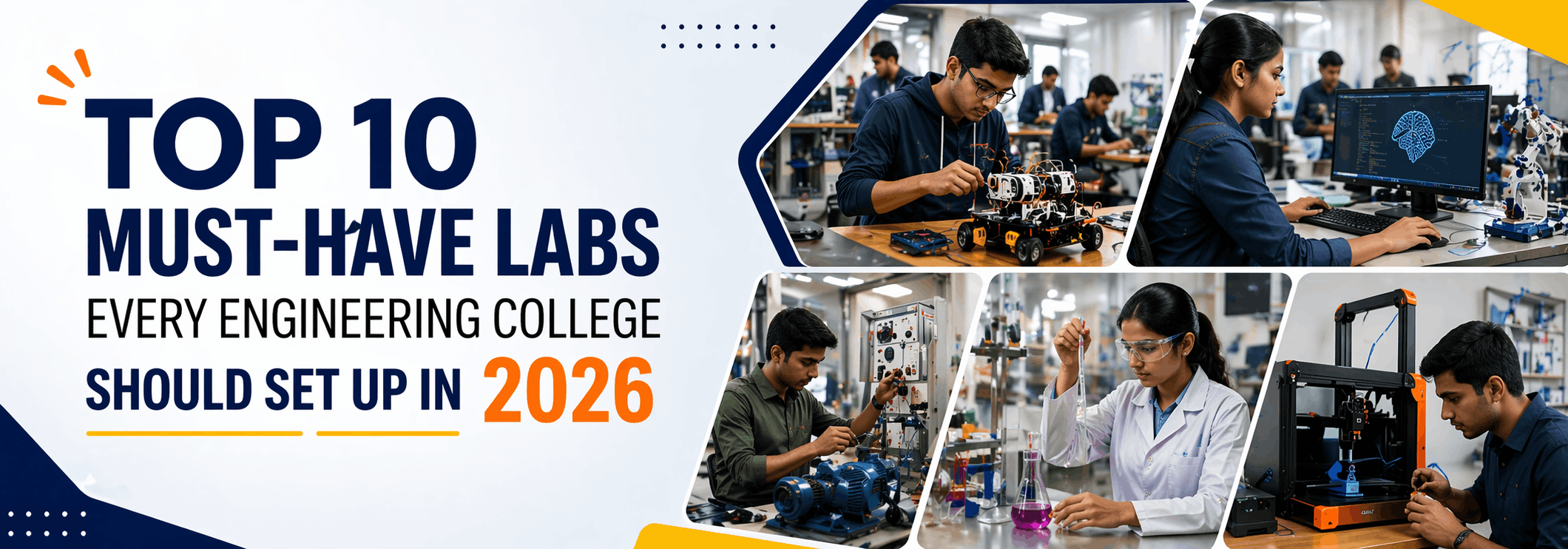
So, which innovation labs for engineering colleges in India actually move the needle? Here are the ten that every serious institution should be thinking about -and how HexNBit helps colleges bring each one to life.
If there’s one lab that has gone from “nice to have” to “non-negotiable” in the last two years, it’s this one. The demand for AI-skilled engineers in India is not slowing down. It’s accelerating.
A well-designed AI & ML Lab gives students access to real datasets, GPU-enabled workstations, and frameworks like TensorFlow, PyTorch, and Scikit-learn. Students don’t just learn what a neural network is -they build one. They train models on real-world data. They learn to deploy predictions. The difference between reading about predictive modeling and actually building a working model is the difference between a student who can explain AI and one who can create it.
HexNBit’s AI & Machine Learning Lab solutions cover everything from hardware procurement to curriculum integration, giving colleges a complete, ready-to-teach environment that’s aligned with industry hiring requirements.
Automation is not coming -it’s already here. Every manufacturing, logistics, and smart infrastructure company in India is integrating robotics and IoT into its core operations. Engineering graduates who can’t interface with these systems are going to find themselves at a serious disadvantage.
A Robotics & IoT Lab gives students a hands-on environment where they design and program robots, integrate IoT sensors, build automation workflows, and monitor systems through cloud-based dashboards. The learning is end-to-end -from understanding hardware schematics to writing the code that makes the machine move.
HexNBit sets up Robotics & IoT Labs that are built around real industry workflows, not just hobbyist kits. The equipment is professional-grade. The curriculum is placement-oriented.
India is racing toward a digital-first economy. Every bank, every hospital, every government department is moving online. And someone needs to defend all of that. With over 1.5 million cybersecurity roles expected to remain unfilled in India, engineering colleges that ignore this domain are leaving their students behind before they even start.
A proper Cybersecurity Lab isn’t a room full of laptops. It’s a controlled, isolated environment where students simulate real attacks, analyze malware, practice incident response, and build the kind of intuition that only hands-on threat work can develop. Ethical hacking labs, VLAN-isolated networks, diverse OS environments -these are the components of a lab that actually produces job-ready security professionals.
HexNBit’s Cybersecurity Lab setups include air-gapped network infrastructure, virtualization environments for running attack/defense scenarios, and structured learning pathways that prepare students for certifications like CEH, CompTIA Security+, and OSCP.
India’s semiconductor ambitions are serious. The government’s ₹76,000 crore semiconductor mission is creating an entire ecosystem of chip design companies, fab units, and EDA tool providers. Colleges that build VLSI capabilities now will be the ones producing the talent pipeline this industry desperately needs.
A VLSI & Semiconductor Lab teaches students VLSI design, simulation, hardware description languages like VHDL and Verilog, and the fundamentals of semiconductor device fabrication. Students work with industry-standard EDA tools and develop the deep electronics foundation that chip design careers require.
HexNBit helps engineering colleges set up VLSI Labs that are aligned with what companies like Qualcomm, Intel, and ISRO’s VSSC are actually looking for when they recruit from campus.
5. AR/VR & Immersive Technology Lab
The metaverse conversation has matured. AR and VR are no longer experimental curiosities -they’re active tools in healthcare training, industrial design, military simulation, and architectural visualization. Engineers who understand immersive technology have opportunities across industries that simply didn’t exist five years ago.
An AR/VR Lab equips students to build interactive simulations, develop 3D experiences, and apply immersive tech to real-world problem-solving. Whether the career goal is gaming, healthcare tech, smart manufacturing, or product design -this lab creates relevant, future-facing skills.
HexNBit’s AR/VR Lab solutions bring professional-grade headsets, development environments like Unity and Unreal Engine, and project-based learning into your campus.
Drones are changing how India does agriculture, disaster management, surveillance, delivery, and defense. The government’s drone policy liberalization and PLI schemes for drone manufacturing have created a genuine industry -and it needs engineers who know this technology from the inside out.
A Drone Technology Lab lets students explore UAV design, aerodynamics, flight control systems, and navigation. They apply what they build to real-world contexts -precision agriculture monitoring, search-and-rescue simulations, logistics path planning.
HexNBit’s drone lab setups are designed for engineering colleges that want to give their students a competitive edge in one of India’s fastest-growing emerging sectors.
7. Smart Agriculture & AgriTech Lab
Here’s a lab that often surprises administrators but consistently delights students: a Smart Agriculture Lab. India is an agricultural nation that also happens to be a technology powerhouse. Combining the two is not just a commercial opportunity -it’s a social responsibility.
Students learn to build sensor networks for soil monitoring, design smart irrigation systems using IoT, apply computer vision for crop health analysis, and develop precision farming solutions powered by AI. This lab is especially impactful for colleges in Tier 2 and Tier 3 cities, where connections to the agricultural economy are direct and meaningful.
HexNBit’s Smart Agriculture Lab solutions bring together IoT hardware, data analytics platforms, and field-relevant use cases that make the learning immediately applicable.
8. DevOps & Cloud Computing Lab
Software doesn’t just get written anymore. It gets built, tested, deployed, monitored, updated, and scaled -continuously. DevOps has fundamentally changed how software teams operate, and students who enter the workforce without understanding CI/CD pipelines, containerization, and cloud infrastructure are going to struggle from day one.
A DevOps & Cloud Lab trains students in tools like Docker, Kubernetes, Jenkins, GitHub Actions, and cloud platforms like AWS, Azure, and GCP. The focus is on building the operational mindset -not just writing code, but shipping it reliably and at scale.
HexNBit’s DevOps Lab setups create cloud-connected environments where students practice real deployment workflows, not just follow theoretical tutorials.
9. Chip Design Lab
Distinct from a VLSI Lab’s focus on simulation and design theory, a Chip Design Lab goes deeper into microchip architecture, hardware description, and the physical realization of electronic designs. Students dive into processor design, memory architectures, and the emerging world of custom silicon.
As India positions itself as a global chip design hub -particularly with companies like Apple, Samsung, and AMD expanding their Indian R&D footprints -the demand for engineers with chip-level expertise has never been higher.
HexNBit helps colleges build Chip Design Labs that are professionally equipped and academically structured to feed directly into this talent demand.
10. AICTE IDEA Lab (Innovation, Design & Entrepreneurship)
Every lab on this list builds a specific technical skill. The AICTE IDEA Lab builds something broader and arguably more important: the mindset to create.
An IDEA Lab -short for Innovation, Design, and Entrepreneurship Application Lab -is a multidisciplinary space where students from any engineering branch come together to solve real problems using design thinking, prototyping tools, and emerging technologies. It’s where the next generation of student entrepreneurs, intrapreneurs, and research scholars develop their ideas into working solutions.
AICTE’s IDEA Lab framework is also one of the most accessible funding pathways for engineering colleges looking to upgrade their innovation infrastructure. HexNBit has deep expertise in helping colleges navigate the AICTE IDEA Lab proposal process, design the physical space, procure the right equipment, and operationalize the lab for maximum student engagement.
How HexNBit Makes This Possible
Setting up a lab sounds straightforward. In reality, it’s complex -equipment selection, vendor coordination, layout design, curriculum mapping, faculty training, government scheme applications, industry partnerships, and ongoing maintenance all need to come together.
HexNBit is not a vendor. It’s a technology and education transformation partner.
With expertise in lab setups, R&D solutions, and government scheme navigation -including AICTE IDEA Lab, PM-USHA, DST-FIST, and RUSA -HexNBit provides end-to-end support from the first planning conversation to the day students walk into a fully functional innovation lab. The team includes domain experts in AI, robotics, VLSI, cybersecurity, and drone technology, along with specialists who understand India’s higher education funding landscape deeply.
For institutions wondering about cost: a basic Robotics & IoT Lab can start from ₹10–20 lakhs, while a comprehensive AI & Machine Learning Centre of Excellence may range from ₹30–75 lakhs or more. Government funding through AICTE IDEA Lab and PM-USHA can offset a significant portion of this investment -and HexNBit’s team guides colleges through the entire proposal and documentation process to maximize approval chances.
The Bottom Line
The engineering colleges that will dominate placement records, attract research funding, and build genuine industry reputation in the next decade are the ones making bold infrastructure decisions today. Innovation labs for engineering colleges in India aren’t a luxury upgrade -they’re the foundation of a relevant, future-ready institution.
Whether you’re a government-aided college looking to leverage PM-USHA funding, an AICTE-approved institution aiming to establish an IDEA Lab, or a private university ready to build a comprehensive Centre of Excellence -the roadmap starts with the right lab partner.
Ready to transform your campus? Explore HexNBit’s full lab portfolio at www.hexnbit.com and take the first step toward building an institution that industry actually wants to partner with.